


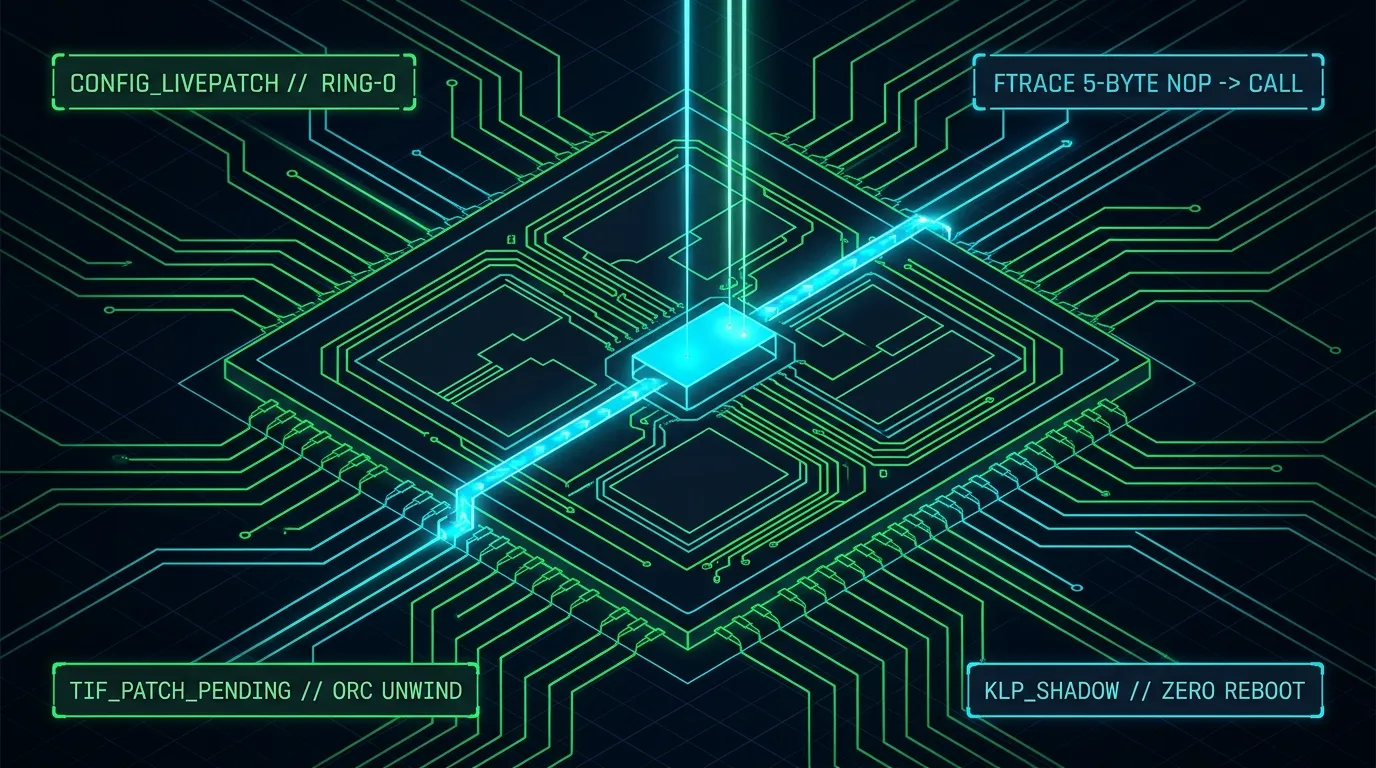
Zero-Downtime Silicon Surgery: Authoring Linux Kernel Livepatches (klp & kpatch-build) to Remediate Ring-0 CVEs Without Rebooting
Imagine you are operating a fleet of 128 bare-metal GPU nodes running a 72-hour distributed training job—or a high-frequency KVM hypervisor cluster holding 4 TB of pinned guest memory—when an urgent local privilege escalation CVE drops in net/netfilter/nf_tables_api.c or fs/io_uring.c.
Rebooting those nodes to boot a new vmlinuz kernel image means tearing down active RDMA Queue Pairs, flushing terabytes of warm page/KV caches, and incurring hours of cluster orchestration downtime. Leaving the nodes unpatched exposes Ring-0 to container escape.
Linux Kernel Livepatching (CONFIG_LIVEPATCH / klp) solves this dilemma by performing surgical, in-memory function replacement on the running kernel—splicing patched C functions into Ring-0 execution paths in microseconds without dropping a single TCP socket, CUDA context, or KVM guest thread.
Here is the internal engineering breakdown of how klp hijacks function prologues via ftrace, how the kernel’s Hybrid Per-Task Consistency Model prevents torn state across SMP cores, how to add new struct fields to live kernel objects using Shadow Variables (klp_shadow_alloc), how Atomic Cumulative Replacement (.replace = true) upgrades stacked patches, and how to compile and load your own custom livepatch module with kpatch-build.
1. How CONFIG_LIVEPATCH Redirects Execution Inside Ring-0 (ftrace + NOP Sleds)
How can the Linux kernel replace an arbitrary compiled C function—say, nf_tables_newrule()—while 128 CPU cores are actively executing inside the kernel?
The secret lies in a compiler flag enabled on every modern enterprise and upstream Linux kernel (CONFIG_DYNAMIC_FTRACE_WITH_REGS=y / CONFIG_DYNAMIC_FTRACE_WITH_ARGS=y with CONFIG_HAVE_DYNAMIC_FTRACE_WITH_DIRECT_CALLS):
- When the kernel is compiled with
-pg -mfentry(or-fpatchable-function-entry=5), GCC/Clang inserts a 5-bytecall __fentry__instruction at the very first byte of every non-inlined kernel function (immediately afterendbr64if Intel CETCONFIG_X86_KERNEL_IBTis active). - At boot time (
ftrace_init), the kernel overwrites all of those 5-bytecall __fentry__instructions with a single hardware 5-byteNOPinstruction (0f 1f 44 00 00,nopl 0x0(%rax,%rax,1)) so normal execution pays zero cycle overhead. - When you load a Livepatch module (
insmod livepatch-cve-2026.ko),klpregisters anftrace_opshandler withFTRACE_OPS_FL_IPMODIFYon the target function’s address and atomically text-pokes (text_poke_bp) that 5-byteNOPinto acall klp_ftrace_handler:
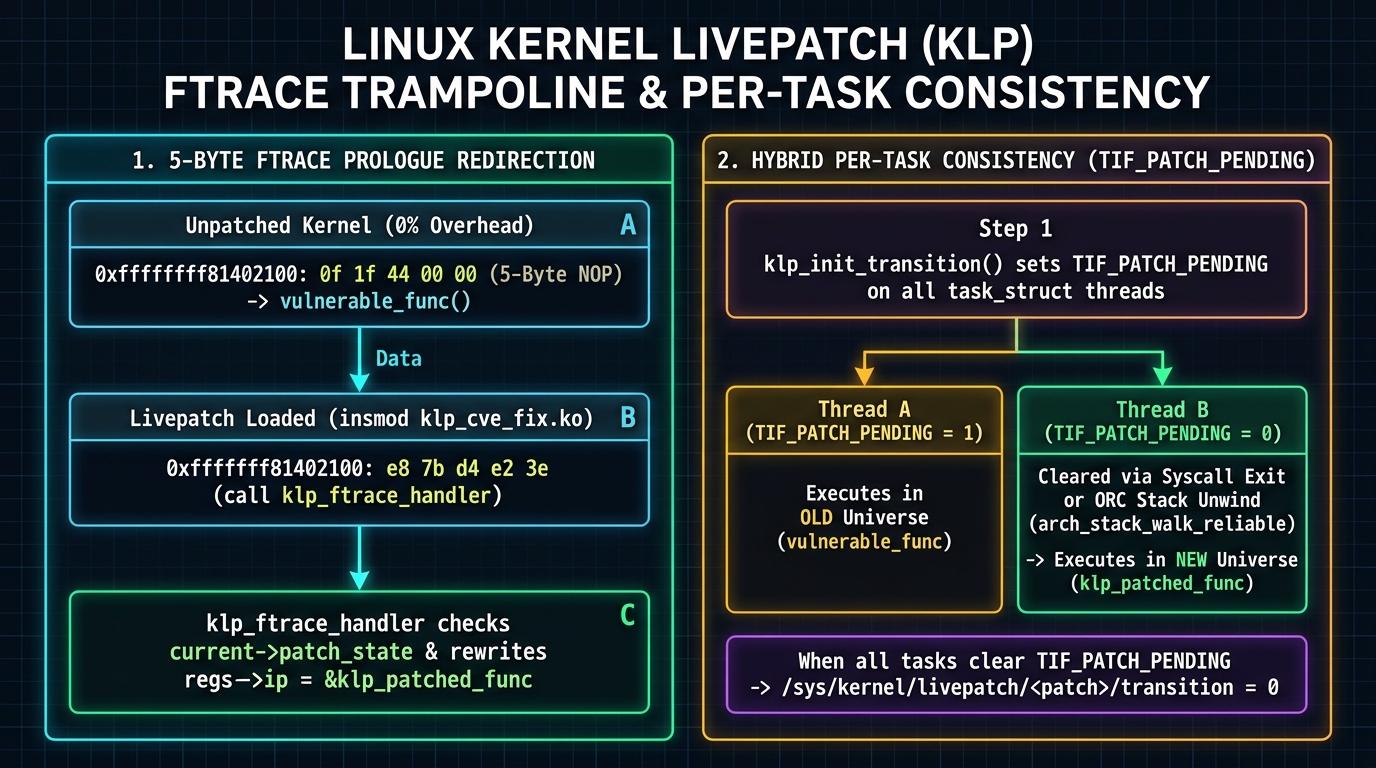
+-------------------------------------------------------------------------------+
|          LINUX KERNEL LIVEPATCH (KLP) FTRACE TRAMPOLINE REDIRECTION           |
+-------------------------------------------------------------------------------+
|                                                                               |
|  [ BEFORE LIVEPATCH (Zero Overhead) ]                                         |
|    vulnerable_func():                                                         |
|      0xffffffff81402100:  0f 1f 44 00 00    nopl   0x0(%rax,%rax,1)           |
|      0xffffffff81402105:  55                push   %rbp                       |
|      0xffffffff81402106:  48 89 e5          mov    %rsp,%rbp                  |
|      ... (executes vulnerable C code) ...                                     |
|                                                                               |
|  ---------------------------------------------------------------------------  |
|                                                                               |
|  [ AFTER LIVEPATCH LOADED ]                                                   |
|    vulnerable_func():                                                         |
|      0xffffffff81402100:  e8 7b d4 e2 3e    call   klp_ftrace_handler         |
|                                                      |                        |
|      +-----------------------------------------------+                        |
|      v                                                                        |
|    klp_ftrace_handler(ip, parent_ip, fops, fregs):                            |
|      ├── Reads RCU-protected `func = list_first_or_null_rcu(&ops->func_stack)`|
|      ├── Checks `current->patch_state` (`TIF_PATCH_PENDING`)                  |
|      ├── Rewrites instruction pointer: `ftrace_regs_set_instruction_pointer`  |
|      └── `ret` jumps directly into `klp_patched_func()`!                      |
|                                                                               |
+-------------------------------------------------------------------------------+
When klp_ftrace_handler() (kernel/livepatch/patch.c) intercepts the function entry, it inspects the calling task’s patch_state and modifies the saved instruction pointer (ftrace_regs_set_instruction_pointer(fregs, (unsigned long)func->new_func)) to point to your replacement function inside the livepatch .ko module. When klp_patched_func() returns, it returns directly to parent_ip—skipping the original vulnerable function body completely!
2. The Hybrid Per-Task Consistency Model (TIF_PATCH_PENDING & ORC Unwinding)
What if CPU 4 is already halfway through executing vulnerable_func() (or sleeping on a mutex inside a callee of vulnerable_func()) at the exact microsecond CPU 0 loads a livepatch that patches both vulnerable_func() and its sibling helper_func()?
If CPU 4 resumed inside vulnerable_func() using the old locking or reference-counting semantics and then called helper_func() executing the new semantics, the kernel would immediately panic or corrupt slab memory.
To prevent mixed-version execution within any thread’s call chain, Linux klp enforces a Hybrid Per-Task Consistency Model (kernel/livepatch/transition.c) combining kGraft-style syscall boundary tracking with kpatch-style stack unwinding:
- Initialize Transition (
klp_init_transition): When a livepatch starts transitioning towardKLP_TRANSITION_PATCHED, the kernel sets each task’stask->patch_state = KLP_TRANSITION_UNPATCHEDand sets the thread flagTIF_PATCH_PENDINGon every singletask_structin the system (for_each_process_thread). - Per-Thread Execution Universe (
OLDvs.NEW): Insideklp_ftrace_handler(), the kernel readspatch_state = current->patch_state. As long as a task hasTIF_PATCH_PENDINGset (KLP_TRANSITION_UNPATCHED),klp_ftrace_handler()directs that task to the OLD functions. The moment a task clearsTIF_PATCH_PENDING, itspatch_stateflips toKLP_TRANSITION_PATCHEDand it permanently enters the NEW patched function universe. - Three Mechanisms to Clear
TIF_PATCH_PENDING:- Syscall / Trap Return Boundary (
klp_update_patch_state): Whenever any userspace thread exits the kernel back to Ring-3 (exit_to_user_mode_loop), its kernel call stack is guaranteed to be 100% empty! It cannot be inside any patched kernel function, so the kernel clearsTIF_PATCH_PENDINGand switches the task toKLP_TRANSITION_PATCHEDinO(1)time. - Reliable Stack Unwinding (
klp_check_stack+ORCUnwinder): What about idle CPUs (swapper/N), kernel threads (kworker,ksoftirqd,vhost-net), or tasks sleeping inepoll_wait()? A periodic workqueue (klp_transition_work) invokestask_call_func()to freeze each non-running task’s stack and runsarch_stack_walk_reliable()(backed by compile-timeobjtoolORCunwind tables viaCONFIG_HAVE_RELIABLE_STACKTRACE=y). If none of the functions on the task’s stack are in the patch’sklp_funclist, the task is safely switched toKLP_TRANSITION_PATCHED! - Fake Signal Wakeup (
klp_send_signals) &force: If a task remains stalled inTIF_PATCH_PENDINGfor more than 15 seconds (for example, blocked in an interruptible sleep or tightvhostloop),klpsends a benign fake signal (SIGSTOP/TIF_SIGPENDINGwakeup without delivering a fatal signal) to nudge the thread across the kernel/user boundary.
- Syscall / Trap Return Boundary (
Once every task in the system clears TIF_PATCH_PENDING, klp_complete_transition() runs, /sys/kernel/livepatch/<patch>/transition flips from 1 -> 0, and old superseded livepatch modules (when .replace = true) are automatically unlinked!
3. Writing a Livepatch in C: klp_patch, klp_shadow_alloc, and .replace = true
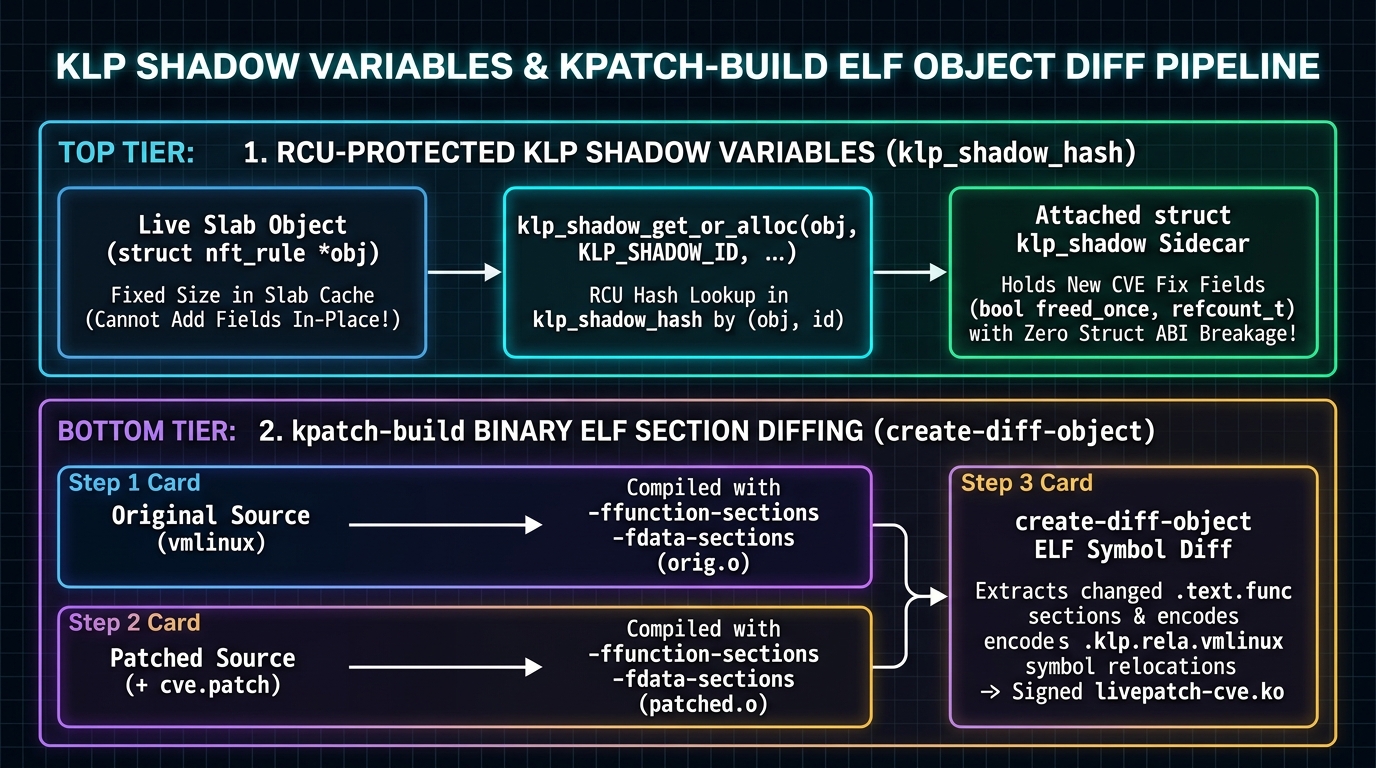
What if fixing a CVE (such as a double-free or missing generation check in struct nft_rule or struct file) requires adding a new bool or refcount_t field to an existing kernel struct? You cannot modify the C struct definition directly in a livepatch because thousands of struct nft_rule objects are already allocated with the old size in the kernel’s SLUB allocator!
Instead, CONFIG_LIVEPATCH provides Shadow Variables (<linux/livepatch.h>) and State Callbacks (struct klp_callbacks):
klp_shadow_get_or_alloc(obj, id, size, gfp_flags, ctor, ctor_data)attaches an RCU-protected sidecar structure to any existing kernel pointerobjinside the globalklp_shadow_hashtable (kernel/livepatch/shadow.c).- Setting
.replace = trueonstruct klp_patchenables Atomic Cumulative Livepatching: the new livepatch atomically replaces all previously loaded livepatches in a single transition, creating dynamicnoptrampolines to revert any previously patched functions that are no longer modified by the cumulative patch.
Here is a complete, production-structured C livepatch (livepatch_cve_2026_fix.c) demonstrating Shadow Variables, Pre/Post-Patch Callbacks, and Cumulative Atomic Replace:
// SPDX-License-Identifier: GPL-2.0
// livepatch_cve_2026_fix.c — Ring-0 Livepatch with Shadow Variables & Callbacks
#define pr_fmt(fmt) KBUILD_MODNAME ": " fmt

#include <linux/module.h>
#include <linux/kernel.h>
#include <linux/livepatch.h>
#include <linux/seq_file.h>
#include <linux/slab.h>
#include <linux/jiffies.h>

#define KLP_SHADOW_CVE_2026_ID 0x20261030UL

struct seq_cve_shadow {
    u64 first_access_jiffies;
    pid_t creator_pid;
    bool sanitized;
};

/*
 * Replacement function for proc_cmdline_show().
 * Attaches an out-of-band shadow struct to `struct seq_file *m` via RCU hash
 * lookup without altering sizeof(struct seq_file) in the SLUB cache.
 */
static int klp_proc_cmdline_show(struct seq_file *m, void *v)
{
    struct seq_cve_shadow *shadow;

    shadow = klp_shadow_get_or_alloc(m, KLP_SHADOW_CVE_2026_ID,
                                     sizeof(*shadow), GFP_ATOMIC,
                                     NULL, NULL);
    if (shadow && !shadow->sanitized) {
        shadow->first_access_jiffies = get_jiffies_64();
        shadow->creator_pid = current->pid;
        shadow->sanitized = true;
    }

    seq_printf(m, "%s klp_cve_2026_remediated=1\n", saved_command_line);

    /* Free shadow metadata when object lifecycle completes */
    klp_shadow_free(m, KLP_SHADOW_CVE_2026_ID, NULL);
    return 0;
}

/* Pre-patch and post-unpatch lifecycle callbacks */
static int klp_pre_patch_cb(struct klp_object *obj)
{
    pr_info("Preparing Ring-0 ftrace transition for object: %s\n",
            obj->name ? obj->name : "vmlinux");
    return 0;
}

static void klp_post_unpatch_cb(struct klp_object *obj)
{
    /* Sweep any remaining shadow variables matching KLP_SHADOW_CVE_2026_ID */
    klp_shadow_free_all(KLP_SHADOW_CVE_2026_ID, NULL);
    pr_info("Cleaned up all shadow variables for KLP_SHADOW_CVE_2026_ID\n");
}

static struct klp_func vmlinux_funcs[] = {
    {
        .old_name = "proc_cmdline_show",
        .new_func = klp_proc_cmdline_show,
    },
    { }
};

static struct klp_object patch_objs[] = {
    {
        /* NULL targets core vmlinux; set to e.g. "nf_tables" for a .ko module */
        .name = NULL,
        .funcs = vmlinux_funcs,
        .callbacks = {
            .pre_patch = klp_pre_patch_cb,
            .post_unpatch = klp_post_unpatch_cb,
        },
    },
    { }
};

static struct klp_patch livepatch_cve_2026 = {
    .mod = THIS_MODULE,
    .objs = patch_objs,
    /* Atomic replace: supersedes any older loaded livepatches cleanly */
    .replace = true,
};

static int __init livepatch_cve_init(void)
{
    return klp_enable_patch(&livepatch_cve_2026);
}

static void __exit livepatch_cve_exit(void)
{
}

module_init(livepatch_cve_init);
module_exit(livepatch_cve_exit);
MODULE_LICENSE("GPL");
MODULE_INFO(livepatch, "Y");
4. Automated Binary ELF Section Diffing with kpatch-build & .klp.rela Relocations
In production, hand-writing struct klp_func wrappers breaks down as soon as a patched C function accesses a file-scoped static variable or calls an unexported static helper inside vmlinux—because a normal loadable kernel module (.ko) can only resolve EXPORT_SYMBOL globals!
How does Red Hat’s kpatch-build solve unexported static symbols and inlined callees automatically?
- Dual Compilation with Function/Data Sections:
kpatch-buildinterceptsKbuildand compiles the target kernel twice with-ffunction-sections -fdata-sections—placing every individual C function into its own.text.<func_name>ELF section (orig.ovs.patched.o). - Binary ELF Comparison (
create-diff-object):create-diff-objectparses the DWARF debug info and ELF relocation tables oforig.oandpatched.o, automatically pulling in any callers whose inlined functions changed. - Special
.klp.rela.<objname>Sections (SHF_RELA_LIVEPATCH): For any unexportedstaticsymbol referenced by the patched function,kpatch-buildemits a special ELF relocation section.klp.rela.vmlinux..text.klp_funcusing symbol names formatted as.klp.sym.vmlinux.<symbol_name>,<sympos>(where<sympos>disambiguates duplicatestaticsymbol names across different.cfiles inkallsyms). When the module loads (or when a delayed target module likenf_tables.koloads later), the kernel’sklp_write_section_relocs()resolves those unexported addresses directly fromkallsyms!
#!/usr/bin/env bash
set -euo pipefail

# 1. Build a cumulative livepatch .ko directly from a unified git diff (cve-2026-nft.patch)
#    against the exact debuginfo vmlinux of your running kernel:
kpatch-build \
  --sourcerpm /var/cache/kernel-src/linux-6.12.8.src.rpm \
  --vmlinux /usr/lib/debug/lib/modules/$(uname -r)/vmlinux \
  --jobs $(nproc) \
  cve-2026-nft.patch

# 2. Inspect the synthesized .klp.rela symbol relocations and klp_funcs inside the .ko
readelf -SW livepatch-cve-2026-nft.ko | grep -E "\.klp\.rela|\.text\."

# 3. Sign the livepatch module with your fleet MOK / SecureBoot X.509 key
/usr/src/kernels/$(uname -r)/scripts/sign-file \
  sha512 /etc/keys/mok_priv.der /etc/keys/mok_pub.der \
  livepatch-cve-2026-nft.ko

# 4. Load the livepatch and monitor per-task consistency convergence in sysfs
insmod livepatch-cve-2026-nft.ko
cat /sys/kernel/livepatch/livepatch_cve_2026_nft/enabled     # 1
cat /sys/kernel/livepatch/livepatch_cve_2026_nft/transition  # 0 (All tasks converged!)

# 5. Diagnose any pinned thread holding TIF_PATCH_PENDING during a slow transition:
grep -rn "1" /proc/[0-9]*/task/[0-9]*/patch_state 2>/dev/null || echo "0 pending tasks"
5. Production Comparison: Reboot vs. User-Space kexec vs. CONFIG_LIVEPATCH
How does CONFIG_LIVEPATCH compare against alternative kernel remediation strategies across a 128-node GPU or KVM hypervisor fleet?
| Remediation Strategy | Kernel Cutover Latency | TCP / RDMA QP Survival | GPU CUDA / KVM Guest State |
Can Change sizeof(struct)? |
|---|---|---|---|---|
| Full BIOS / UEFI Reboot | 180 s – 420 s |
Dropped (100% Reset) | Lost (Full re-init) | Yes (New vmlinux) |
Fast Reboot (kexec -e) |
12 s – 35 s |
Dropped (100% Reset) | Lost (Unless pkram/VFIO-preserve) |
Yes (New vmlinux) |
CONFIG_LIVEPATCH (klp + klp_shadow) |
< 15 ms (Zero Downtime!) |
100% Preserved | 100% Preserved (Zero Stall) | Via klp_shadow_alloc() |
With CONFIG_LIVEPATCH + kpatch-build, you can neutralize critical Ring-0 vulnerabilities across hundreds of bare-metal servers in milliseconds—preserving 100% workload uptime until your next scheduled maintenance window.
Interactive Linux Kernel Livepatch (`klp`) ftrace Trampoline & Per-Task Consistency Simulator
Step through `insmod livepatch-cve.ko` to observe 5-byte `ftrace` prologue patching (`0f 1f 44 00 00` -> `call klp_ftrace_handler`), per-task `TIF_PATCH_PENDING` convergence across Ring-3 syscall exits and `ORC` stack unwinding (`arch_stack_walk_reliable`), and `klp_shadow_alloc()` double-free prevention.
Step Through `klp_enable_patch()` & Per-Task Consistency Convergence
Per-Task Consistency Matrix (`task_struct->patch_state`)
Each task switches independently from the OLD to the NEW function universe once its Ring-0 stack is proven free of patched functions.
[klp] Ready: 5-byte NOP (0f 1f 44 00 00) at nf_tables_newrule+0x0/0x580// ABOUT THE AUTHOR
Joshua Edward McLaughlin Cox
Technomancer & Systems ArchitectPassionate about low-level Linux systems engineering, high-scale Kubernetes deployments, local artificial intelligence pipelines, and defensive security. Building robust, sovereign computing environments that stand the test of time.