


Breaking the PCIe Memory Wall: CXL 3.0/3.1 Memory Pooling, Cache-Coherent Switch Fabrics, and Linux DAMON Tiering
For two decades, datacenter server architecture has been held hostage by DIMM-Slot Stranding and the CPU Pin-Count Wall: if a workload requires 4 TB of DRAM, you are forced to purchase a dual-socket 192-core server populated with high-density 128 GB or 256 GB DDR5 RDIMMs—even if your service only utilizes 25% of the CPU cores. Worse, once all 12 DDR5 channels per socket are populated, both memory capacity and memory bandwidth hit an immovable physical ceiling dictated by socket package pins.
Compute Express Link (CXL 2.0 / 3.0 / 3.1) breaks this coupling. Built atop the physical PCIe 5.0 (32 GT/s NRZ) and PCIe 6.0 (64 GT/s PAM4) electrical layers, CXL multiplexes three hardware-coherent protocols (CXL.io, CXL.cache, and CXL.mem) that allow CPUs and accelerators to address external memory expanders and multi-rack memory pools using standard load/store (MOV) instructions with 64-byte cacheline granularity.
Here is the systems engineering breakdown of CXL Type-3 Memory Expanders, CXL 3.0/3.1 256-Byte Latency-Optimized FLITs (LO-Flit), Port-Based Routing (PBR) switch fabrics with hardware Back-Invalidation (HDM-DB), the real nanosecond latency math, and how to configure the Linux kernel (dax_kmem, ZONE_MOVABLE, weighted_interleave, and DAMON DAMOS_MIGRATE_HOT/COLD) to run tiered memory in production without p99 tail-latency cliffs or Ring-0 Machine Check panics.
1. Inside the CXL Protocol Stack: Why CXL.mem Is Not PCIe DMA
Standard NVMe SSDs and PCIe NICs transfer data in 4 KB+ pages over PCIe TLP (Transaction Layer Packet) streams, requiring kernel device drivers, submission/completion ring buffers, interrupts, and DMA page pinning.
CXL Type-3 (CXL.io + CXL.mem) bypasses the OS I/O stack entirely and executes directly inside the CPU’s coherent Home Agent / Integrated Memory Controller (iMC / CHA) pipeline:
- System Address Decoder (
SAD) &CFMWSLookup: When a CPU thread suffers a Last-Level Cache (L3) miss on a Host Physical Address (HPA) mapped to an ACPI CXL Fixed Memory Window Structure (CFMWS), the CPU’s Home Agent intercepts the miss in silicon—no kernel driver or page fault is invoked. - Low-Latency FLIT Encapsulation: Instead of variable-length PCIe TLPs, the Home Agent packs the 64-byte cacheline request into a fixed-size Flow Control Unit (
FLIT):- CXL 1.1 / 2.0 (PCIe 5.0 @ 32 GT/s NRZ): Uses a 68-byte FLIT (528-bit payload + 16-bit CRC with 128b/130b encoding).
- CXL 3.0 / 3.1 (PCIe 6.0 @ 64 GT/s PAM4): Introduces the Standard 256-Byte FLIT and the Latency-Optimized 256-Byte FLIT (
LO-Flit), which splits each 256B transfer into two 128B sub-flits with independent CRCs—shaving 3 to 5 ns off serialization/deserialization latency so the memory controller can begin decoding the address before the second half of the flit even arrives.
- Six Asymmetric
CXL.memChannels:CXL.memseparates traffic into Master-to-Subordinate (M2S, CPU $\to$ Device) and Subordinate-to-Master (S2M, Device $\to$ CPU) channels to prevent protocol deadlocks:M2S Req: Address-only requests (MemRd,MemInv).M2S RwD: Requests with Data (MemWr,MemWrPtl64B cacheline evictions).M2S BIRsp: Back-Invalidation Response (added in CXL 3.0; CPU confirms local cacheline invalidation).S2M NDR: No-Data Response (Cmp,Cmp-Ewrite/exclusivity completions).S2M DRS: Data Response (MemDatareturning the 64-byte cacheline into CPU L3/L2/L1D).S2M BISnp: Back-Invalidation Snoop (added in CXL 3.0; allows the CXL memory controller to snoop and invalidate host CPU caches).
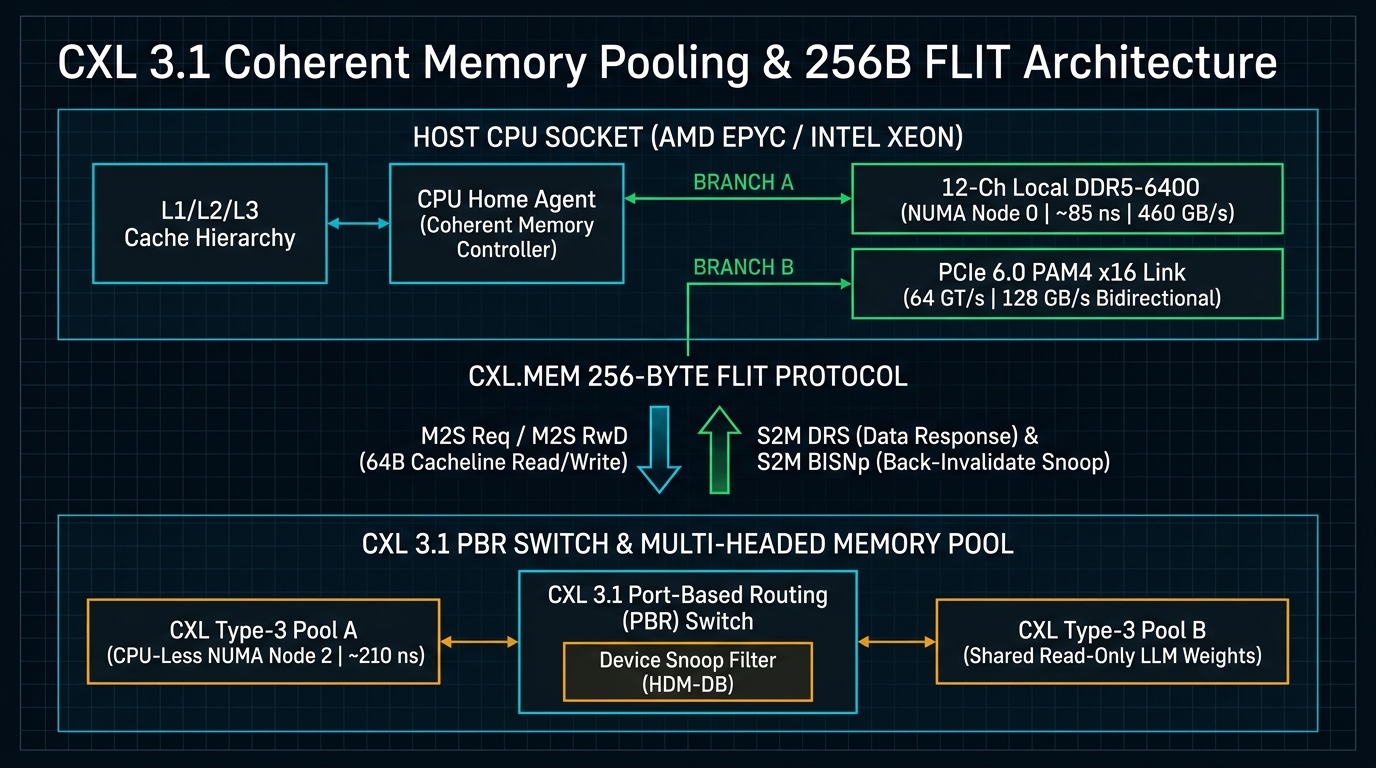
+-------------------------------------------------------------------------------+
|          CXL 3.1 SWITCHED MEMORY POOL & LINUX KERNEL NUMA TOPOLOGY            |
+-------------------------------------------------------------------------------+
|                                                                               |
|  [ Host Node 0 (AMD EPYC / Intel Xeon) ]                                      |
|    ├── NUMA Node 0 (Local 12-Ch DDR5-6400)  ---> Latency: ~85 ns  (Hot Tier)  |
|    └── CPU Home Agent / CXL Root Port (x16 PCIe 6.0 PAM4 @ 64 GT/s = 128 GB/s)|
|                                       |                                       |
|             [ 256B LO-Flits: M2S Req/RwD/BIRsp <-> S2M DRS/NDR/BISnp ]        |
|                                       |                                       |
|  [ CXL 3.1 Hardware PBR (Port-Based Routing) Switch Fabric ]                  |
|    ├── Dynamic Capacity Device (DCD) Extent Management                        |
|    └── Device Snoop Filter (HDM-DB) Issuing `S2M BISnp` Across Sharers        |
|           +---------------------------+---------------------------+           |
|           v                                                       v           |
|  +---------------------------------+     +---------------------------------+  |
|  | CXL Type-3 Pool Appliance A     |     | CXL Type-3 Pool Appliance B     |  |
|  | Exposed as Zero-CPU NUMA Node 2 |     | Exposed as Zero-CPU NUMA Node 3 |  |
|  | Latency: ~210-250 ns (Warm/Cold)|     | Shared Read-Only LLM Weights    |  |
|  +---------------------------------+     +---------------------------------+  |
+-------------------------------------------------------------------------------+
Coherency Models: HDM-H (CXL 2.0) vs. HDM-DB (CXL 3.0/3.1)
A common misconception is that CXL 2.0 and CXL 3.0 treat multi-host memory the same way. They do not:
- CXL 2.0 Memory Pooling (
HDM-H— Host-Only Coherent): A Multi-Logical Device (MLD) can slice a 2 TB memory appliance into four isolated 512 GB logical devices assigned to four different servers. Each slice is coherent only within its single owning host. - CXL 3.0/3.1 True Memory Sharing (
HDM-DB— Device Back-Invalidation Coherent): Combined with Port-Based Routing (PBR) switches scaling up to 4,096 ports, CXL 3.0/3.1 embeds a hardware Device Snoop Filter (DSF) directory inside the Type-3 memory controller. Multiple servers can map the exact same physical DRAM pages simultaneously. If Host A writes to a shared cacheline that Host B holds inShared (S)state, the CXL controller transmits anS2M BISnpsnoop across the switch to Host B, waits forM2S BIRsp, and guarantees strict hardware cache coherency across nodes—enabling zero-copy shared LLM weight pools and lock-free distributed in-memory tables.
2. The Real Latency & Bandwidth Math: Local DDR5 vs. CXL Type-3
Because every CXL.mem access traverses the CPU Root Port, PCIe PHY Serializer/Deserializer (SerDes), link layer, and external CXL ASIC memory controller before reaching DRAM ranks, CXL Type-3 memory behaves architecturally like a 1-hop or 2-hop CPU-less remote NUMA node:
| Memory Tier | Idle Load-to-Use Latency | Peak Read Bandwidth (per x16 / Socket) |
Linux Kernel memory_tier (adistance) |
Ideal Workload Placement |
|---|---|---|---|---|
| Local CPU Socket DDR5-6400 (12-Channel) | ~82–90 ns | ~460 GB/s | memory_tier4 (576) |
Hot working sets, kernel stacks (ZONE_NORMAL), HNSW entry layers |
| Remote CPU Socket DDR5 (1-Hop UPI/xGMI) | ~135–150 ns | ~150–200 GB/s | memory_tier4 (NUMA distance 21) |
Cross-socket thread allocations |
Direct-Attach CXL 2.0 AIC (PCIe 5.0 x16, 68B Flit) |
~170–195 ns | ~60–62 GB/s per x16 |
memory_tier22 (~2176) |
Warm in-memory caches (Valkey), JVM heaps, KV-cache offload |
Direct-Attach CXL 3.1 AIC (PCIe 6.0 x16, 256B LO-Flit) |
~150–168 ns | ~118–124 GB/s per x16 |
memory_tier18 (~1792) |
Bandwidth expansion (weighted_interleave), OLAP scans |
| Switched CXL 3.1 PBR Fabric (1 Switch Hop) | ~220–265 ns | Shared up to 128 GB/s / port | memory_tier26 (~2688) |
Cold memory pages, vector DB payload blocks, shared LLM weights |
Local NVMe SSD (PCIe 5.0 Swap / io_uring) |
~12,000–65,000 ns | ~14 GB/s | Block Swap (zswap / swap) |
Persistent block storage ($50\times\text{–}250\times$ slower than CXL!) |
The Bandwidth Pinhole Insight
While switched CXL memory (~235 ns) is $2.6\times$ slower in point-latency than local DDR5 (~85 ns), it is still $50\times\text{ to }250\times$ faster than NVMe flash and is directly addressable at 64-byte granularity without page-fault context switches. Furthermore, adding four x16 CXL 3.0/3.1 links to a single-socket server injects up to 480 GB/s of additional read bandwidth on top of the CPU’s native 460 GB/s DDR5 channels—nearly doubling single-socket memory bandwidth (~940 GB/s aggregate) when striped via Linux 6.9+ weighted interleaving.
3. Configuring Linux Zero-CPU NUMA Nodes (cxl-cli, CDAT, & ZONE_MOVABLE)
When the Linux kernel (6.8+ / 6.12+) boots on a platform with CXL memory, it combines firmware tables with hardware device telemetry to build its memory tier hierarchy:
- ACPI
CEDT(CXL Early Discovery Table) &SRAT/HMAT: Describes the host bridge (CHBS) and fixed memory windows (CFMWS). - PCIe DOE &
CDAT(Coherent Device Attribute Table): The Linuxcxl_coredriver queries the CXL Type-3 device’s internalCDATtable over the PCIe Data Object Exchange (DOE) mailbox (drivers/cxl/core/cdat.c), combining link and device latency/bandwidth metrics to compute an abstract distance (adistance) and place the CPU-less NUMA node into a lower kernel memory tier (e.g.,/sys/devices/virtual/memory_tiering/memory_tier22).
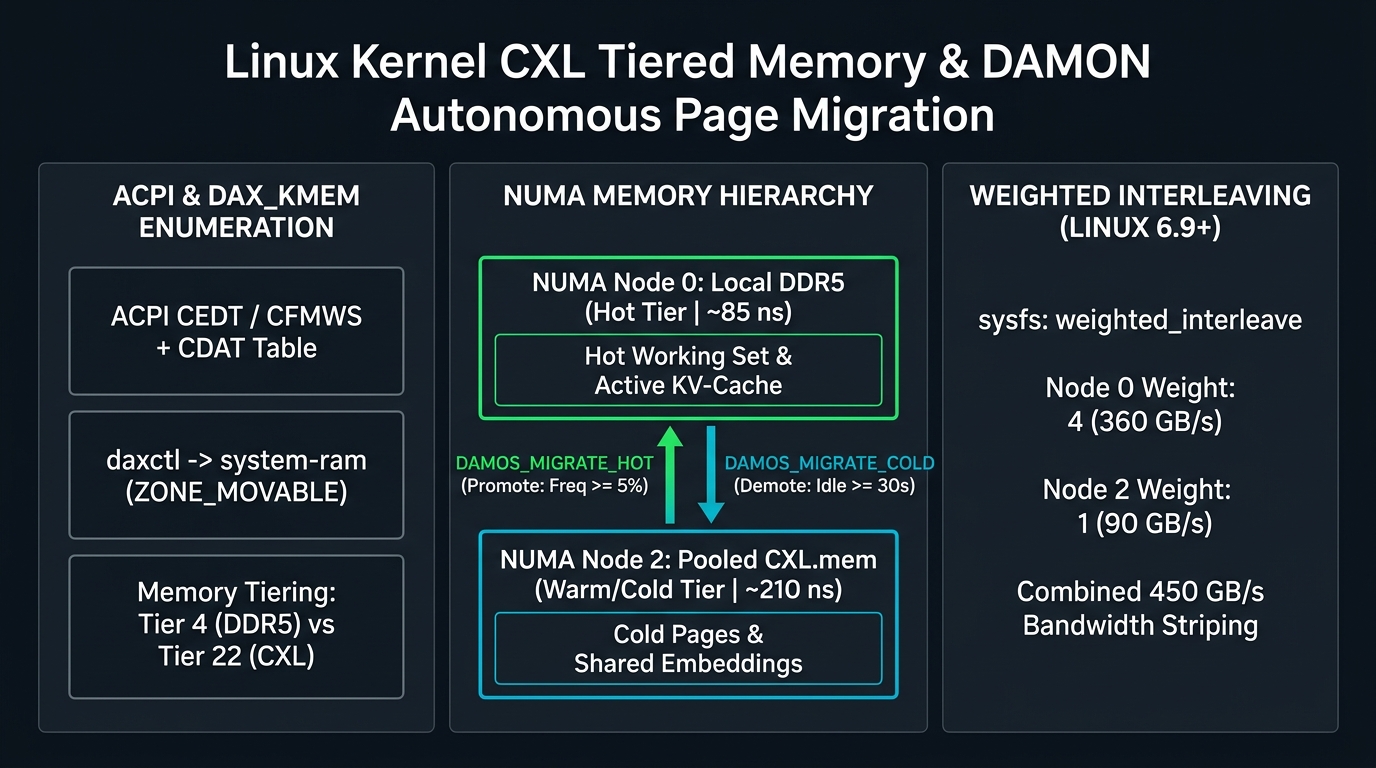
Step 1: Provision a CXL Region and Online It into ZONE_MOVABLE
CRITICAL PRODUCTION RAS RULE: Never allow the Linux kernel to place unmovable Ring-0 slab allocations (
kmalloc, kernel stacks,task_struct, or radix page tables) onto CXL memory (ZONE_NORMAL). If a CXL switch port resets, a Dynamic Capacity (DCD) extent is released, or an uncorrectable DRAM error returns aCXL.mem Poisonbit during a kernel pointer dereference, the host CPU raises a fatal Ring-0 Machine Check Exception (MCE) and panics the entire server.Always online CXL memory exclusively into
ZONE_MOVABLEso all pages on the CXL NUMA node remain 100% migratable (__GFP_MOVABLE) and any uncorrectable poison error is contained to a recoverable userspaceSIGBUS(BUS_MCEERR_AR).
#!/usr/bin/env bash
set -euo pipefail

# 1. Inspect discovered CXL memdevs, endpoints, and ACPI Root Bridges (CFMWS decoders)
cxl list -M -D -R

# 2. Create a 2-way hardware-interleaved CXL RAM region across two x16 endpoints (mem0, mem1)
#    4096-byte interleave granularity (-g 4096) maximizes multi-link bandwidth
cxl create-region -m -d decoder0.0 -w 2 -g 4096 mem0 mem1

# 3. Reconfigure the resulting DAX device (dax0.0) into system-ram mode (dax_kmem driver)
#    --no-online prevents udev from defaulting blocks into ZONE_NORMAL
daxctl reconfigure-device --mode=system-ram --no-online dax0.0

# 4. Online all CXL memory blocks strictly into ZONE_MOVABLE (safe for hot-unplug & migration)
daxctl online-memory dax0.0 --movable

# 5. Verify the CPU-less NUMA node (Node 2) and its assigned kernel memory_tier
numactl --hardware
grep -H . /sys/devices/virtual/memory_tiering/memory_tier*/nodelist
# Output:
# /sys/devices/virtual/memory_tiering/memory_tier4/nodelist:0-1   (Local DDR5)
# /sys/devices/virtual/memory_tiering/memory_tier22/nodelist:2    (Pooled CXL.mem)
Step 2: Bandwidth-Weighted Interleaving (Linux 6.9+ & numactl 2.0.18+)
Standard round-robin numactl --interleave=0,2 sends 50% of traffic to Node 0 (460 GB/s) and 50% to Node 2 (115 GB/s), starving the fast DDR5 channels while saturating the CXL link.
Linux 6.9+ introduced Weighted Memory Interleaving (/sys/kernel/mm/mempolicy/weighted_interleave/), which reads HMAT/CDAT bandwidth attributes (or accepts explicit administrator ratios) to stripe page allocations across Local DDR5 and CXL in exact proportion to their sustained bandwidth (4:1 or 2:1):
# 1. Enable automatic kernel page demotion from Local DDR5 (Tier 4) -> CXL (Tier 22) during kswapd pressure
sysctl -w vm.zone_reclaim_mode=0
echo 1 > /sys/kernel/mm/numa/demotion_enabled

# 2. Configure 4:1 bandwidth-weighted interleaving (e.g., 460 GB/s Local DDR5 : 115 GB/s CXL)
echo 4 > /sys/kernel/mm/mempolicy/weighted_interleave/node0
echo 1 > /sys/kernel/mm/mempolicy/weighted_interleave/node2

# 3. Launch a bandwidth-bound analytics or LLM CPU KV-cache offload engine across the weighted pool
numactl --weighted-interleave=0,2 ./vllm-kv-offload-worker --kv-cache-dtype fp8
4. Autonomous Hot/Cold Page Tiering with Linux DAMON (DAMOS_MIGRATE_HOT / COLD)
Linux provides two mechanisms for promoting hot pages from CXL back to local DDR5:
- Reactive Hinting Faults (
kernel.numa_balancing=2, Transparent Page Placement /TPP): Periodically unmaps pages (PROT_NONE) so the next CPU access triggers a minor page fault into the kernel, which measures access recency and promotes the page. While easy to enable, heavy pointer-chasing workloads (like HNSW vector search or Redis/Valkey) can suffer minor page-fault storms that inflate p99 tail latency by 3%–8%. - Proactive Sampling with Linux
DAMON(Linux 6.11+DAMOS_MIGRATE_HOT/DAMOS_MIGRATE_COLD): Instead of trapping threads with page faults, thekdamondkernel thread samples hardware Page Table Entry (PTE)Accessedbits across dynamically split/merged physical address regions (ops: paddr), bounding monitoring CPU overhead to <1% regardless of RAM size.
In Linux 6.11+, DAMOS (DAMON-based Operation Schemes) gained native migrate_hot and migrate_cold actions (mm/damon/paddr.c), enabling direct page migration between NUMA nodes based on exact access frequency and idle age watermarks.
Discovering Physical Address Ranges & Applying the damo Policy
First, inspect /proc/iomem (or damo args damon --ops paddr) to confirm the Host Physical Address (HPA) boundaries of Node 0 (Local DDR5) and Node 2 (hmem / kmem CXL region):
# Inspect physical address ranges for Local DDR5 (Node 0) and CXL System RAM (Node 2)
grep -E "System RAM|hmem" /proc/iomem
# 100000000-807fffffff : System RAM          (Node 0: 512 GB Local DDR5)
# 10000000000-1ffffffffff : System RAM (kmem) (Node 2: 1024 GB CXL Type-3 Pool)
Next, deploy the bi-directional tiering policy via damo:
# /etc/damon/cxl-tiering-policy.yaml — Apply via: sudo damo start /etc/damon/cxl-tiering-policy.yaml
kdamonds:
  - state: on
    contexts:
      - name: cxl_tiered_ram
        ops: paddr
        monitoring_attrs:
          intervals:
            sample_us: 5000       # 5ms PTE Accessed-bit sampling interval
            aggr_us: 100000       # 100ms aggregation window (20 samples/window)
            ops_update_us: 1000000
          nr_regions:
            min: 32
            max: 2048
        targets:
          - regions:
              # Region 0: Local DDR5 (NUMA Node 0 HPA range)
              - start: 0x100000000
                end:   0x8080000000
              # Region 1: Pooled CXL.mem (NUMA Node 2 HPA range)
              - start: 0x10000000000
                end:   0x20000000000
        schemes:
          # Scheme A: Demote cold pages from Local DDR5 (Node 0) -> CXL (Node 2)
          - name: demote_cold_to_cxl
            access_pattern:
              sz_bytes: { min: 4096, max: max }
              nr_accesses: { min: 0, max: 0 }
              age_us: { min: 30000000, max: max } # Untouched for >= 30 seconds
            action: migrate_cold
            target_nid: 2
            quotas:
              time_ms: 50
              sz_bytes: 268435456 # Rate-limit demotion to 256 MB/sec
              reset_interval_ms: 1000
            watermarks:
              metric: free_mem_rate
              interval_us: 5000000
              high: 200           # Pause demotion when >20.0% free RAM
              mid: 150            # Trigger demotion when <15.0% free RAM
              low: 50

          # Scheme B: Immediately promote hot pages from CXL (Node 2) -> Local DDR5 (Node 0)
          - name: promote_hot_to_ddr5
            access_pattern:
              sz_bytes: { min: 4096, max: max }
              nr_accesses: { min: 5, max: max }   # Accessed in >=25% of samples (5/20)
              age_us: { min: 100000, max: max }
            action: migrate_hot
            target_nid: 0
            quotas:
              time_ms: 100
              sz_bytes: 536870912 # Allow fast 512 MB/sec promotion bursts
              reset_interval_ms: 1000
5. Production Architecture: Where CXL 3.1 Wins (and Where to Guard It)
1. LLM Prefix-Cache Offloading & Multi-Host Weight Sharing (vLLM / SGLang)
In multi-turn agentic workloads, GPU HBM3e (80–192 GB) fills up rapidly with KV-cache tensors. Evicting warm KV-cache blocks to NVMe SSD (~25,000 ns) stalls Time-To-First-Token (TTFT) on subsequent turns, whereas offloading warm KV blocks to a 4 TB CXL 3.1 Type-3 pool (~160–220 ns) delivers $8\times\text{ to }14\times$ higher prefix-cache restoration throughput. With CXL 3.1 HDM-DB shared memory regions, multiple inference hosts can also memory-map (mmap over /dev/dax0.0) a single read-only copy of 405B/671B model weights during cold container startup in milliseconds.
2. Vector Databases (Milvus / Qdrant HNSW Graphs)
Hierarchical Navigable Small World (HNSW) indexes exhibit a bimodal memory access pattern:
- Upper Graph Layers (0–15% of footprint): Extremely hot, random 64-byte pointer-chasing reads. Must remain pinned in Local DDR5 (
Node 0, ~85 ns). - Bottom Layer & Raw Vector Payloads (85% of footprint): Scanned only for candidate re-ranking. Placed on CXL (
Node 2, ~180 ns) viaDAMON, cutting total DRAM hardware CAPEX by 40%–48% while keeping p99 recall latency within 3.2% of an all-local DDR5 cluster.
3. Production Readiness Checklist
Before shifting production workloads onto CXL 3.0/3.1 memory pools, enforce these four invariants:
ZONE_MOVABLEEnforcement: Verifycat /proc/buddyinfoshows zero allocations inNode 2, zone Normaland all CXL capacity inNode 2, zone Movable.- Interleave Granularity Alignment: Match ACPI
CFMWSandcxl create-region -ginterleave granularity (256Bor4096B) to your CPU Home Agent’s native hashing mode so multi-port CXL cards do not suffer single-link hot-spotting. - Disable
zone_reclaim_mode: Setvm.zone_reclaim_mode=0so the kernel demotes cold pages from Node 0 to Node 2 rather than prematurely reclaiming page cache on Node 0. - CXL RAS & Post-Package Repair (
sPPR) Monitoring: Runrasdaemon(--enable-cxl) to monitorcxl_poisonandcxl_aer_uetracepoints, proactively retiring degraded device DRAM rows before multi-bit ECC errors occur.
Interactive CXL 3.0/3.1 Memory Tiering, Bandwidth Striping & FLIT Coherency Simulator
Model composite nanosecond read latency, sustained DDR5 + CXL bandwidth striping (`weighted_interleave`), hardware CAPEX savings, and Linux 6.11+ `DAMON` (`DAMOS_MIGRATE_HOT` / `COLD`) policies—or inspect 256B `LO-Flit` and `S2M BISnp` back-invalidation traces.
# 1. Online CXL region into ZONE_MOVABLE & verify memory_tier assignment
daxctl reconfigure-device --mode=system-ram --no-online dax0.0
daxctl online-memory dax0.0 --movable
cat /sys/devices/virtual/memory_tiering/memory_tier18/nodelist  # Output: 2

# 2. Launch Linux 6.11+ DAMON autonomous hot/cold migration (DAMOS_MIGRATE_HOT / COLD)
damo start --ops paddr --sample 5ms --aggr 100ms \
  --damos_action migrate_hot --damos_Access_rate 5% 100% --damos_quota_space 512M \
  --damos_action migrate_cold --damos_age 30s max --damos_quota_space 256M
// ABOUT THE AUTHOR
Joshua Edward McLaughlin Cox
Technomancer & Systems ArchitectPassionate about low-level Linux systems engineering, high-scale Kubernetes deployments, local artificial intelligence pipelines, and defensive security. Building robust, sovereign computing environments that stand the test of time.