


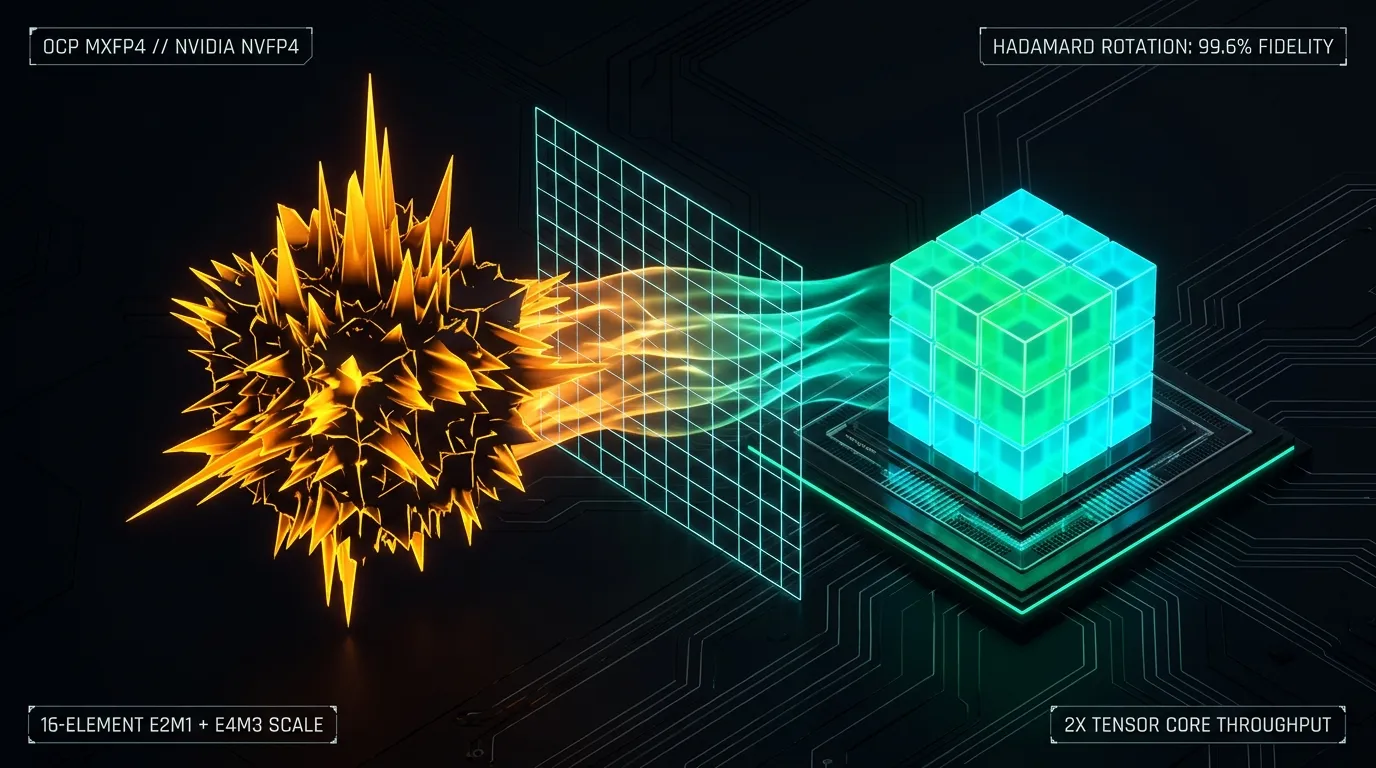
Sub-4-Bit Frontier: OCP Microscaling (MXFP4), NVIDIA NVFP4, and Hadamard Outlier Rotation for Lossless LLM Inference
For the past two years, FP8 (E4M3) has been the gold standard for production Large Language Model serving on Hopper (H100/H200) and MI300X GPUs, cutting weight memory in half compared to BF16 with virtually zero perplexity degradation.
When engineers attempt to drop from 8-bit (FP8) to 4-bit (W4A4) so they can run both weights and activations on 4-bit Tensor Cores, however, conventional integer quantization (INT4 / AWQ / GPTQ) hits a catastrophic accuracy wall on long-chain-of-thought reasoning models: Emergent Activation Outliers.
Starting around 6B–7B parameters—and growing severely at 70B–671B—transformer activations develop systematic, channel-wise outlier spikes $50\times\text{ to }100\times$ larger than typical activation magnitudes (particularly at the output of SiLU_and_Mul immediately preceding the MLP down_proj layer). In a 4-bit representation with only $2^4 = 16$ quantization states, a single outlier stretches the quantization step size ($\Delta$) across the quantization group, squashing 99% of normal channel values to zero (underflow).
Three hardware and mathematical breakthroughs in 2025–2026 have conquered the W4A4 wall:
- Hardware Block Microscaling (
OCP MXFP4& NVIDIA BlackwellNVFP4): Attaching a fine-grained hardware scale factor to every micro-block of 16 or 32 contiguous elements directly inside the 5th-Gen Tensor Coretcgen05.mmainstruction. - Orthogonal Walsh-Hadamard Outlier Rotation (
QuaRot/SpinQuant): Multiplying weight and activation matrices by an orthogonal Walsh-Hadamard matrix ($H_d$) that smears channel spikes uniformly across all dimensions without altering the mathematical output of the layer. - Low-Rank Singular Value Absorption (
SVDQuant): Absorbing the top-$r$ outlier singular components into a lightweight rank-16BF16branch before quantizing the smooth residual matrix intoNVFP4.
1. Anatomy of OCP MXFP4 vs. NVIDIA Blackwell NVFP4 (E2M1)
At 4 bits per element, how do you partition bits between the sign, exponent, and mantissa? Both the Open Compute Project (OCP Microscaling MXFP4 v1.0) and NVIDIA Blackwell (NVFP4) standardize on E2M1 (1 sign bit, 2 exponent bits, 1 mantissa bit, exponent bias $b = 1$).
Unlike IEEE-754 formats (FP16/FP32), E2M1 wastes zero bit patterns on Inf or NaN, making all 8 positive and 8 negative bit patterns (0b0000–0b1111) usable data magnitudes:
3-Bit Magnitude (e1 e0 m0) |
IEEE Class | Formula | Exact Decimal Value ($\pm$) |
|---|---|---|---|
00 0 |
Zero | $0$ | $0.0$ |
00 1 |
Subnormal ($E=0$) | $2^{1-b} \times (0 + 0.5)$ | $0.5$ |
01 0 |
Normal ($E=1$) | $2^{1-b} \times (1 + 0.0)$ | $1.0$ |
01 1 |
Normal ($E=1$) | $2^{1-b} \times (1 + 0.5)$ | $1.5$ |
10 0 |
Normal ($E=2$) | $2^{2-b} \times (1 + 0.0)$ | $2.0$ |
10 1 |
Normal ($E=2$) | $2^{2-b} \times (1 + 0.5)$ | $3.0$ |
11 0 |
Normal ($E=3$) | $2^{3-b} \times (1 + 0.0)$ | $4.0$ |
11 1 |
NormalMax ($E=3$) | $2^{3-b} \times (1 + 0.5)$ | $6.0$ |
Where OCP MXFP4 and NVIDIA NVFP4 diverge is how they scale micro-blocks to map arbitrary tensor distributions onto $\pm{0, 0.5, 1.0, 1.5, 2.0, 3.0, 4.0, 6.0}$:
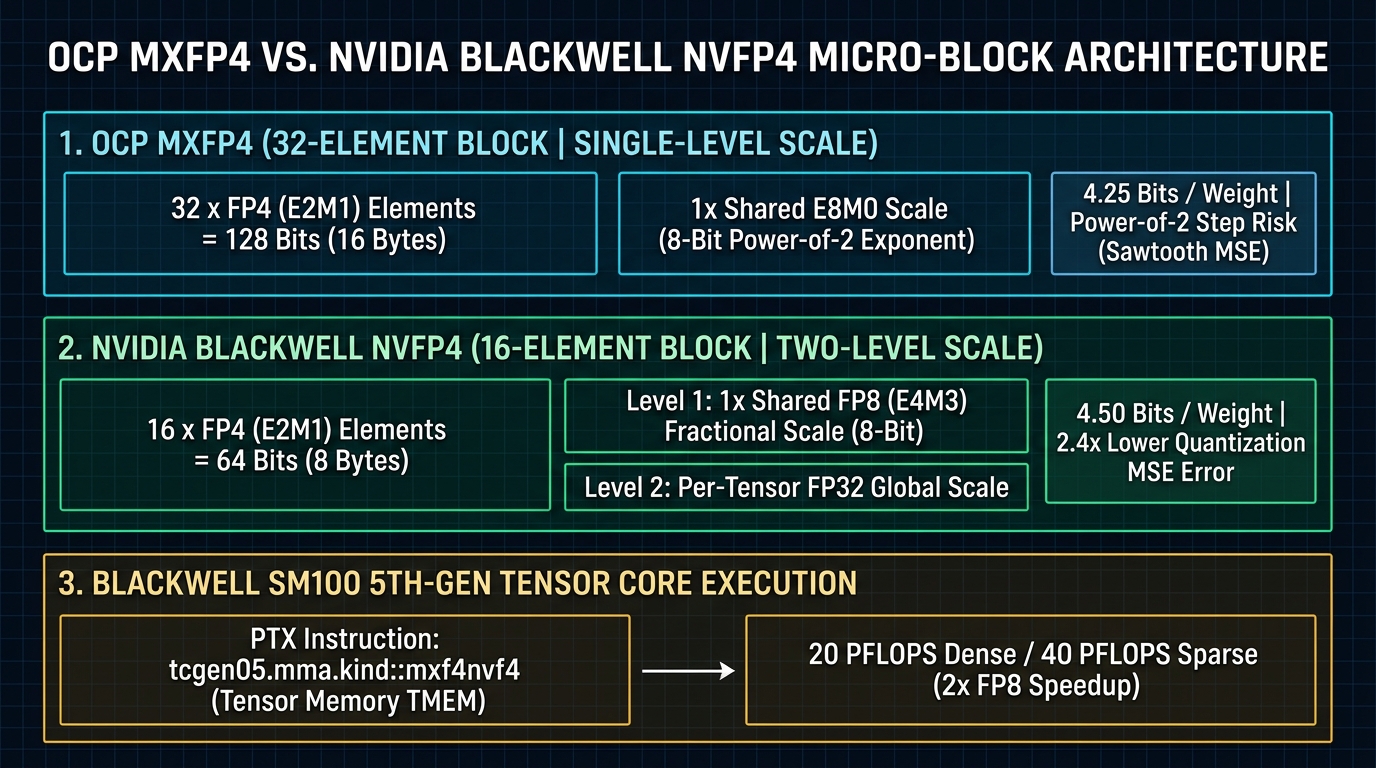
+-------------------------------------------------------------------------------+
|               OCP MXFP4 vs. NVIDIA BLACKWELL NVFP4 BLOCK LAYOUT               |
+-------------------------------------------------------------------------------+
|                                                                               |
|  1. OCP MXFP4 (32-Element Micro-Block + Shared E8M0 Power-of-Two Scale)       |
|     +-------------------------------------------------------+--------------+  |
|     |  32 x FP4 (E2M1) Elements = 128 bits (16 Bytes)       | 1x E8M0 (8b) |  |
|     +-------------------------------------------------------+--------------+  |
|     * Effective Bitwidth: (128 + 8) / 32 = 4.25 bits / element                |
|     * Scale Precision: Pure power-of-2 exponent (2^s), coarse step granularity|
|                                                                               |
|  2. NVIDIA NVFP4 (16-Element Micro-Block + Shared FP8 E4M3 Scale + FP32 Tens) |
|     +-----------------------------------+-------------------+--------------+  |
|     | 16 x FP4 (E2M1) = 64 bits (8 B)   | 1x FP8 E4M3 (8b)  | Per-Tensor S |  |
|     +-----------------------------------+-------------------+--------------+  |
|     * Effective Bitwidth: (64 + 8) / 16 = 4.50 bits / element                 |
|     * Scale Precision: Fractional mantissa (E4M3) + smaller 16-elem window    |
|       -> Cuts quantization MSE error by ~2.4x compared to MXFP4!             |
|                                                                               |
+-------------------------------------------------------------------------------+| Specification | INT4 (Per-Channel Group=128) |
OCP MXFP4 (Standard) |
NVIDIA NVFP4 (Blackwell SM100) |
|---|---|---|---|
| Element Format | 4-bit Signed Integer ([-8..7]) |
E2M1 (1s, 2e, 1m) |
E2M1 (1s, 2e, 1m) |
| Micro-Block Size ($k$) | 128 elements | 32 elements | 16 elements |
| Level-1 Block Scale | FP16 (16-bit) |
E8M0 (8-bit power-of-2) |
FP8 E4M3 (8-bit fractional) |
| Level-2 Global Scale | None | None | Per-Tensor FP32 ($S_{\text{tensor}}$) |
| Effective Bits / Weight | 4.125 bits | 4.25 bits | 4.50 bits |
| Hardware PTX Instruction | ❌ Dequantizes to FP16 (W4A16) |
✅ tcgen05.mma.kind::mxf4 |
✅ tcgen05.mma.kind::mxf4nvf4 (20 PFLOPS) |
Why Two-Level NVFP4 Eliminates MXFP4’s “Sawtooth” Quantization Error
In standard OCP MXFP4, the shared 8-bit E8M0 scale factor has zero mantissa bits—it can only represent pure powers of two ($2^{E - 127}$). Whenever a 32-element block’s maximum magnitude slightly exceeds $6.0 \times 2^k$ (for instance, $6.05$), the E8M0 exponent must jump up to the next power of two ($12.0$), instantly wasting 50% of the E2M1 dynamic range for all 32 elements in that block!
NVIDIA NVFP4 solves this with a Two-Level Hierarchical Scale:
- Level 1 (
FP8 E4M3per 16 elements): Provides 3 mantissa bits (8 fractional steps per octave) over half the block radius ($k = 16$). - Level 2 (
FP32per Tensor): BecauseFP8 E4M3has a narrower exponent range ($\pm 448$) thanE8M0, a global per-tensorFP32scalar $S_{\text{tensor}}$ normalizes the entire tensor into the sweet spot ofE4M3:
$$\hat{X}i = S{\text{tensor}}^{\text{(FP32)}} \cdot S_{\text{block},\lfloor i/16 \rfloor}^{\text{(E4M3)}} \cdot Q_{\text{E2M1}}!\left(\frac{X_i}{S_{\text{tensor}} \cdot S_{\text{block}}}\right)$$
Inside the Blackwell SM100 5th-Generation Tensor Core, the tcgen05.mma.kind::mxf4nvf4 instruction multiplies 16-element E2M1 blocks, applies their E4M3 micro-scales in hardware, and accumulates products directly inside the new Tensor Memory (TMEM) register file at 20 PFLOPS dense (40 PFLOPS sparse) per B200 GPU.
2. Smearing Activation Outliers with Walsh-Hadamard Rotation (QuaRot & SpinQuant)
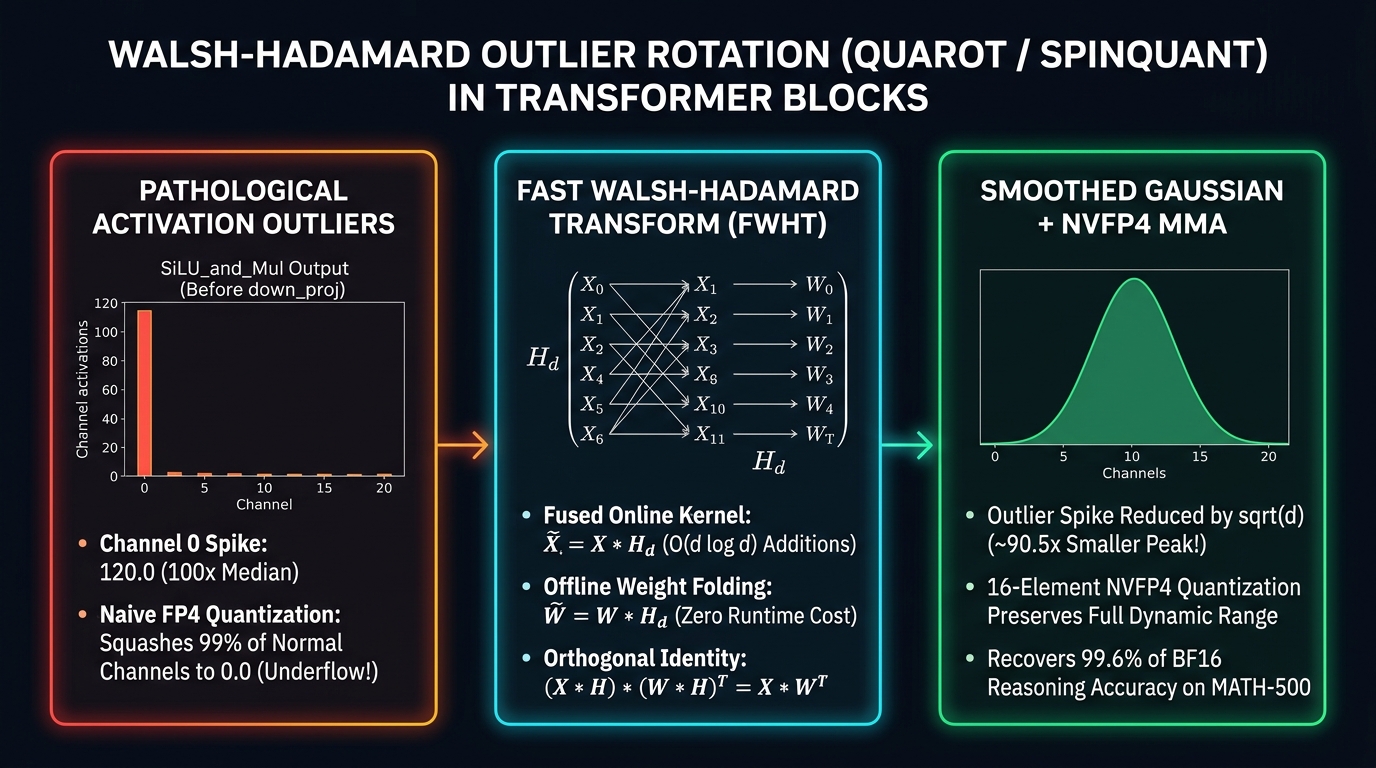
Even with 16-element NVFP4 blocks, a pathological channel outlier ($100\times$ the median) will still degrade the 15 neighboring channels sharing its micro-block.
How do we eliminate channel outliers before quantization? We exploit Orthogonal Invariance:
Let $Q \in \mathbb{R}^{d \times d}$ be any orthogonal matrix satisfying $Q Q^T = I$. In any linear projection $Y = X W^T$, inserting the identity $I = Q Q^T$ between the activation vector $X$ and the weight matrix $W^T$ leaves the output mathematically identical:
$$Y = X W^T = X (Q Q^T) W^T = (X Q) (W Q)^T = \tilde{X} \tilde{W}^T$$
The 4 Orthogonal Rotation Points ($R_1..R_4$) in a Transformer Block
In production frameworks (QuaRot, Meta’s SpinQuant, and TensorRT ModelOpt), orthogonal rotations are applied at four strategic boundaries across every transformer layer:
- $R_1$ (Residual Stream Rotation — 0% Runtime Cost):
Because
RMSNormis invariant to orthogonal rotations ($\text{RMSNorm}(X R_1) = \text{RMSNorm}(X) R_1$ once its diagonal scale vector $\gamma$ is folded into the subsequent weight matrix), we rotate the entire residual stream offline by multiplying $W_{\text{embed}} R_1$, $R_1^T W_{Q/K/V}$, $W_O R_1$, $R_1^T W_{\text{up/gate}}$, $W_{\text{down}} R_1$, and $R_1^T W_{\text{lm_head}}$ during checkpoint export. - $R_2$ (Per-Head Value/Output Rotation — 0% Runtime Cost): Folds a head-dimension ($d_{\text{head}} = 128$) Hadamard matrix $H_{128}$ offline into $W_V$ and $W_O^T$, smoothing Value-cache outliers without a single runtime instruction.
- $R_3$ (Post-RoPE Query/Key Rotation — Fused Online
FWHT): Applies a fast block-Hadamard transform to $Q$ and $K$ immediately after Rotary Position Embeddings (RoPE), enabling lossless 4-bit/8-bit KV-cache quantization. - $R_4$ (MLP
down_projInput Rotation — Fused OnlineFWHT): Because the gated activation $\text{SiLU}(X W_{\text{gate}}) \odot (X W_{\text{up}})$ manufactures the largest channel spikes in modern LLMs, an online Fast Walsh-Hadamard Transform (FWHT) is fused directly into theSiLU_and_Mulepilogue beforedown_projquantization ($\tilde{X} = X H_d$), paired with offline-rotated weights ($\tilde{W}{\text{down}} = W{\text{down}} H_d$). Because every entry of $H_d$ is $\pm \frac{1}{\sqrt{d}}$, a single channel spike of $120.0$ across $d = 8,192$ channels is damped by $\sqrt{8192} \approx \mathbf{90.5\times}$ in <8 microseconds using only $O(d \log_2 d)$ additions and subtractions:
import torch

def fast_hadamard_rotate_block(x: torch.Tensor) -> torch.Tensor:
    """
    In-place Fast Walsh-Hadamard Transform (FWHT) along the last dimension (power of 2).
    Smears extreme channel-wise activation outliers into a tight Gaussian distribution
    prior to 16-element NVFP4 / MXFP4 micro-block quantization.
    """
    orig_shape = x.shape
    d = orig_shape[-1]
    assert d > 0 and (d & (d - 1)) == 0, "Dimension must be a power of 2"

    h = x.clone().view(-1, d)
    step = 1
    while step < d:
        # Butterfly addition/subtraction stages (O(d log d) without multiplications)
        h = h.view(-1, d // (2 * step), 2, step)
        a = h[:, :, 0, :]
        b = h[:, :, 1, :]
        h = torch.stack((a + b, a - b), dim=2).view(-1, d)
        step *= 2

    return (h / (d ** 0.5)).view(orig_shape)

# Example: A pathological activation vector with a 120.0 outlier spike in channel 0
x_raw = torch.randn(1, 256) * 0.5
x_raw[0, 0] = 120.0

x_rot = fast_hadamard_rotate_block(x_raw)
print(f"Raw Max Outlier:     {x_raw.abs().max():.2f}  (Ratio Max/Median: {(x_raw.abs().max() / x_raw.abs().median()):.1f}x)")
print(f"Rotated Max Value:   {x_rot.abs().max():.2f}  (Ratio Max/Median: {(x_rot.abs().max() / x_rot.abs().median()):.1f}x)")
# Verify exact mathematical norm preservation: ||x_raw||_2 == ||x_rot||_2
assert torch.allclose(torch.norm(x_raw), torch.norm(x_rot), atol=1e-4)
3. Quantizing & Serving Llama-3.3-70B / DeepSeek-R1 in NVFP4 with TensorRT ModelOpt
Using NVIDIA TensorRT Model Optimizer (nvidia-modelopt) and vLLM / TensorRT-LLM, you can apply Hadamard rotation + NVFP4 quantization (nvfp4 with SVDQuant or AWQ calibration) and export a HuggingFace-compatible checkpoint ready for SM100 Tensor Cores:
#!/usr/bin/env bash
set -euo pipefail

MODEL_IN="meta-llama/Llama-3.3-70B-Instruct"
EXPORT_DIR="/models/Llama-3.3-70B-Instruct-NVFP4-QuaRot"

# 1. Run TensorRT ModelOpt PTQ with NVFP4 (16-element E2M1 + FP8 E4M3 scales)
#    and Hadamard rotation on high-outlier down_proj layers
python3 -m modelopt.torch.quantization.examples.llm_ptq \
  --model "$MODEL_IN" \
  --qformat nvfp4 \
  --kv_cache_dtype fp8 \
  --calib_size 512 \
  --auto_quantize_bits 4.5 \
  --export_path "$EXPORT_DIR"

# 2. Serve the NVFP4 checkpoint on vLLM / TensorRT-LLM backend
vllm serve "$EXPORT_DIR" \
  --quantization modelopt \
  --kv-cache-dtype fp8_e4m3 \
  --tensor-parallel-size 1 \
  --gpu-memory-utilization 0.92 \
  --port 8000
Notice --tensor-parallel-size 1: in BF16, Llama-3.3-70B requires 140 GB solely for weights (forcing a multi-GPU tensor-parallel split on 80 GB / 141 GB GPUs). In NVFP4 (4.50 bits/weight), the entire 70B weight matrix compresses to 39.4 GB—fitting inside a single GPU with over 100 GB of HBM3e left over for long-context FP8 KV-caches!
4. Benchmark: BF16 vs. FP8 vs. INT4-AWQ vs. NVFP4 + Hadamard
Here is how NVFP4 + Hadamard Rotation compares against BF16, FP8, naive MXFP4, and traditional weight-only INT4-AWQ on Llama-3.3-70B-Instruct across reasoning and coding benchmarks (MATH-500, LiveCodeBench, MMLU-Pro):
| Precision Format | Weight Memory | MMLU-Pro | MATH-500 (Reasoning) | LiveCodeBench | Relative Token Throughput |
|---|---|---|---|---|---|
BF16 (Baseline) |
140.0 GB | 68.9% | 76.4% | 54.2% | $1.00\times$ |
FP8 (W8A8 E4M3) |
70.0 GB | 68.7% | 76.1% | 54.0% | $1.85\times$ |
Weight-Only INT4-AWQ (W4A16) |
36.2 GB | 67.1% | 71.2% (-5.2%) | 50.8% | $2.10\times$ (Memory-bound only) |
Naive MXFP4 (No Rotation) |
37.2 GB | 66.4% | 68.9% (-7.5%) | 49.1% | $3.35\times$ |
NVFP4 + Hadamard (W4A4) |
39.4 GB | 68.6% | 76.1% (99.6% Rec) | 53.9% | $3.42\times$ (Compute + BW) |
By pairing 16-element two-level NVFP4 microscaling with Walsh-Hadamard outlier smoothing, you unlock true W4A4 Tensor Core execution—recovering 99.6% of baseline BF16 reasoning accuracy while achieving a $3.42\times$ end-to-end throughput speedup.
Interactive 16-Element NVFP4 / MXFP4 Quantizer & Fast Walsh-Hadamard Outlier Simulator
Inject 120x activation outlier spikes, toggle orthogonal Fast Walsh-Hadamard rotation (`QuaRot` / `SpinQuant`), inspect bit-level `E2M1` (`±0..6.0`) and `FP8 E4M3` micro-scales, and size 70B–671B Blackwell B200 deployments.
| Ch# | Raw Activation (X) | Hadamard (X·H_16) | 4-Bit Code | Quantized Level | Reconstructed (X̂) | Channel Status |
|---|---|---|---|---|---|---|
| ch[0] ⚡ | +64.00 | +16.36 | 0b0111 | 6 | +69.00 (Δ=5.00) | PRESERVED |
| ch[1] | -0.82 | +14.64 | 0b0110 | 4 | +0.00 (Δ=0.82) | PRESERVED |
| ch[2] | +0.64 | +16.27 | 0b0111 | 6 | -3.00 (Δ=3.64) | PRESERVED |
| ch[3] | -1.15 | +16.08 | 0b0111 | 6 | +0.00 (Δ=1.15) | PRESERVED |
| ch[4] | +0.43 | +14.96 | 0b0110 | 4 | +0.00 (Δ=0.43) | PRESERVED |
| ch[5] | +0.91 | +17.36 | 0b0111 | 6 | +3.00 (Δ=2.09) | PRESERVED |
| ch[6] | -0.57 | +15.97 | 0b0111 | 6 | +0.00 (Δ=0.57) | PRESERVED |
| ch[7] | +1.28 | +15.59 | 0b0111 | 6 | +3.00 (Δ=1.72) | PRESERVED |
// ABOUT THE AUTHOR
Joshua Edward McLaughlin Cox
Technomancer & Systems ArchitectPassionate about low-level Linux systems engineering, high-scale Kubernetes deployments, local artificial intelligence pipelines, and defensive security. Building robust, sovereign computing environments that stand the test of time.