


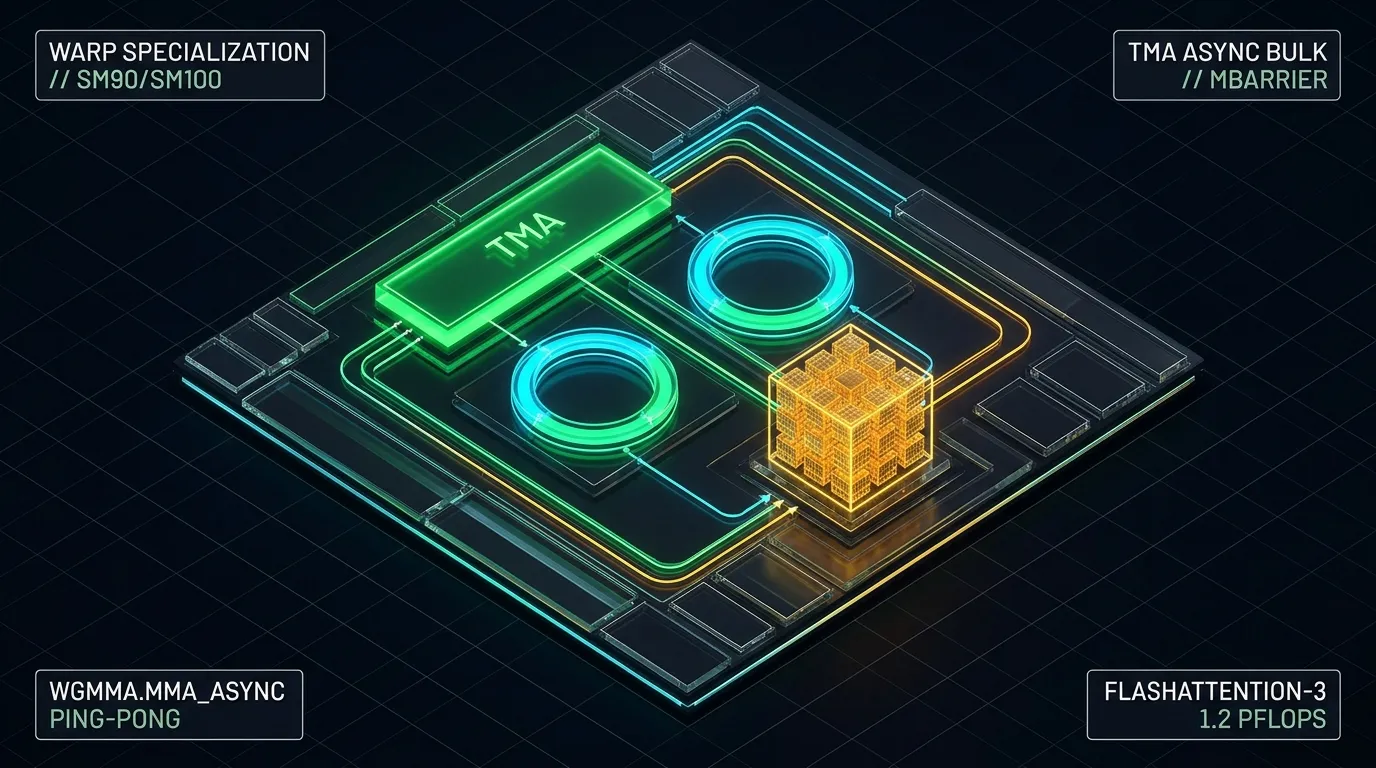
Inside FlashAttention-3 & Warp-Specialized CUDA Kernels: Asynchronous WGMMA, Tensor Memory Accelerator (TMA), and FP8 Ping-Pong Scheduling
When FlashAttention-2 launched on NVIDIA Ampere (A100, SM80), it achieved ~70% of theoretical peak FP16 FLOPs by fusing the $O(N^2)$ attention matrix $S = QK^T$ and online softmax rescaling inside on-chip SRAM. Yet when engineers compiled that exact same synchronous CUDA programming model onto NVIDIA Hopper (H100/H200, SM90), Tensor Core utilization plummeted to 35%.
Why did an architecture with 3x higher Tensor Core throughput (989 TFLOPS BF16 / 1,979 TFLOPS FP8) stall for nearly two-thirds of every clock cycle under a FlashAttention-2 schedule?
Because on Hopper (SM90) and Blackwell (SM100), data movement and Tensor Core matrix multiply-accumulate (WGMMA / tcgen05.mma) are fundamentally asynchronous hardware engines, whereas non-Tensor-Core Special Function Units (SFU / MUFU.EX2 used by softmax) remain synchronous and heavily throughput-limited:
- On an
H100 SXM5, the 4th-generation Tensor Cores execute 1,024 FP16/BF16 operations per clock cycle per SM (wgmma.mma_async), while the Special Function Unit (SFU) computes only 16exp2ftranscendental operations per clock cycle per SM—a 64:1 throughput asymmetry! - Worse, in a classical homogeneous threadblock (
SIMT), every warp executes the same instruction stream: load tile (cp.async), hit__syncthreads(), runmma.sync, hit__syncthreads(), and stall onMUFU.EX2softmax. While theSFUis computingexp2, both the 3.35 TB/s HBM3e bus and the Tensor Cores sit completely idle.
FlashAttention-3 and modern CUTLASS 3.x / ThunderKittens kernels break this wall—reaching 75%–85% Tensor Core utilization (up to 1.2 PFLOPS FP8 on Hopper and 2.25+ PFLOPS on Blackwell)—through four hardware-software co-design primitives: Warp Specialization (setmaxnreg), Tensor Memory Accelerator (TMA) Circular Buffers with mbarrier, Two-Warpgroup Ping-Pong Overlapping, and Blackwell SM100 Dedicated Tensor Memory (TMEM).
1. Warp Specialization: Producer Warpgroups vs. Consumer Warpgroups
In a traditional CUDA kernel, all warps in a Cooperative Thread Array (CTA / Threadblock) are symmetric workers. On SM90+, symmetric warps suffer from Register Pressure Inversion:
- Issuing asynchronous HBM-to-Shared-Memory (
SMEM) transfers requires very few registers (24–40 regs/thread). - Accumulating a $64 \times 128$ or $128 \times 128$
WGMMAtile in registers requires massive register files (232–255 regs/thread, hitting the hardware ceiling of 65,536 32-bit registers per SM).
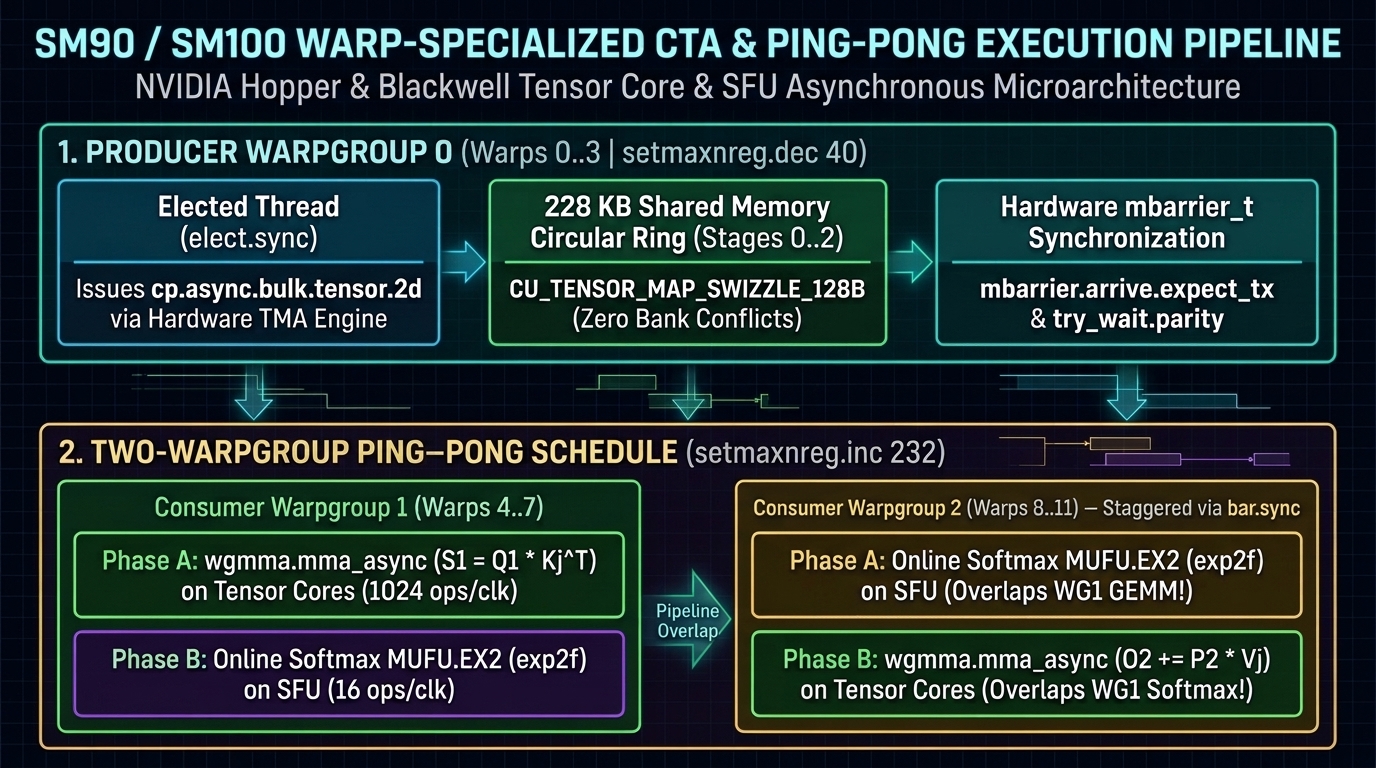
Using PTX setmaxnreg.dec / setmaxnreg.inc, a Warp-Specialized kernel divides a 12-warp (3-Warpgroup, 384-thread) CTA into two asymmetric roles that execute completely independent control-flow loops:
+-----------------------------------------------------------------------------------+
|         SM90 / SM100 WARP-SPECIALIZED CTA & PING-PONG EXECUTION PIPELINE          |
+-----------------------------------------------------------------------------------+
|                                                                                   |
|  [ PRODUCER WARPGROUP 0 (Warps 0..3) — setmaxnreg.dec.sync.aligned 40 ]           |
|    ├── Issues `cp.async.bulk.tensor.2d` via Hardware TMA Engine (0 Addr Regs!)    |
|    ├── Streams K_j, V_j tiles from HBM3e -> 228 KB Shared Memory Circular Ring    |
|    └── Waits on `mbarrier.try_wait.parity` (Consumer Read-Complete Signal)        |
|                           |                                                       |
|                           v  (Hardware `mbarrier.arrive.expect_tx` in SMEM)       |
|  +-----------------------------------------------------------------------------+  |
|  |  CONSUMER WARPGROUP 1 (Warps 4..7)   |  CONSUMER WARPGROUP 2 (Warps 8..11)  |  |
|  |  `setmaxnreg.inc.sync.aligned 232`   |  `setmaxnreg.inc.sync.aligned 232`   |  |
|  +--------------------------------------+--------------------------------------+  |
|  | Step A: `wgmma.mma_async` (S = Q*K^T)| Step A: Softmax `MUFU.EX2` (SFU)     |  |
|  |   [Occupies Tensor Core Pipe 100%]   |   [Occupies SFU Pipe 100% in || !]   |  |
|  +--------------------------------------+--------------------------------------+  |
|  | Step B: Softmax `MUFU.EX2` (SFU)     | Step B: `wgmma.mma_async` (O += P*V) |  |
|  |   [Occupies SFU Pipe 100%]           |   [Occupies Tensor Core Pipe 100%!]  |  |
|  +-----------------------------------------------------------------------------+  |
|                                                                                   |
+-----------------------------------------------------------------------------------+- Producer Warpgroup (
WG0, 4 Warps / 128 Threads): Voluntarily relinquishes its unused registers back to the SM pool viasetmaxnreg.dec.sync.aligned.u32 40. A single elected thread (elect.sync) insideWG0issues asynchronous Tensor Memory Accelerator (TMA) descriptors to stream $K_j$ and $V_j$ tiles from HBM3e into a multi-stage circular buffer in Shared Memory (SMEM). - Consumer Warpgroups (
WG1&WG2, 8 Warps / 256 Threads): Claim the donated registers viasetmaxnreg.inc.sync.aligned.u32 232, holding the query tile $Q_i$, running online softmax statistics $(m_i, \ell_i)$, and output accumulator $O_i$ entirely in register file (RMEM) without spilling a single byte to local memory!
2. Hardware TMA (cp.async.bulk.tensor) & Transaction-Count mbarrier
Prior to Hopper, loading a multidimensional tensor tile $(B, H, N, D)$ from HBM into Shared Memory required every thread in the block to compute 64-bit stride offsets, evaluate boundary predicates for sequence lengths not divisible by 128, and issue cp.async.cg.shared.global 16 bytes at a time.
The Tensor Memory Accelerator (TMA) is a dedicated hardware DMA unit inside each SM that offloads address generation and out-of-bounds zero-padding completely:
- On the host, you initialize a 64-byte
CUtensorMapdescriptor (cuTensorMapEncodeTiled) describing the global HBM tensor base pointer, 5D dimensions, strides, and 128-byte SMEM swizzle layout (CU_TENSOR_MAP_SWIZZLE_128B—which permutes shared memory bank addresses via bitwise XOR soWGMMAmatrix reads suffer zero 32-way bank conflicts). - Inside the kernel, one single thread issues
cp.async.bulk.tensor.2d.shared::cluster.global.mbarrier::complete_tx::byteswhile passing the expected byte count (expect_tx) to a hardware shared-memory barrier (mbarrier_t). The TMA engine transfers the entire $128 \times 128$ tile and atomically decrements thembarriertransaction counter in silicon when the last cacheline lands in SMEM!
Here is how the Producer and Consumer Warpgroups synchronize over a $K$-stage circular SMEM ring using inline PTX mbarrier phase-bit flipping:
// flash_attn3_warp_specialized_tma.cu — Producer/Consumer TMA + WGMMA Loop
#include <cuda.h>
#include <cuda_bf16.h>
#include <cute/tensor.hpp>

__device__ __forceinline__ void warpgroup_reg_dealloc_40() {
    asm volatile("setmaxnreg.dec.sync.aligned.u32 %0;\n" :: "n"(40));
}

__device__ __forceinline__ void warpgroup_reg_alloc_232() {
    asm volatile("setmaxnreg.inc.sync.aligned.u32 %0;\n" :: "n"(232));
}

template <int kStages = 3, int kTileBytes = 32768>
__device__ void producer_tma_loop(
    const CUtensorMap* __restrict__ tma_desc_K,
    const CUtensorMap* __restrict__ tma_desc_V,
    uint64_t* smem_mbar_full,   // Signaled by TMA hardware when tile arrives
    uint64_t* smem_mbar_empty,  // Signaled by Consumer WG when SMEM slot is free
    uint32_t smem_k_base,
    uint32_t smem_v_base,
    int num_kv_blocks,
    int head_offset_y)
{
    warpgroup_reg_dealloc_40(); // Donate 192 regs/thread to Consumer Warpgroups!

    if (threadIdx.x == 0) {     // Only 1 thread in Producer WG issues TMA commands
        int stage = 0;
        uint32_t phase = 0;

        for (int kv_idx = 0; kv_idx < num_kv_blocks; ++kv_idx) {
            // 1. Wait until Consumer Warpgroups finish reading this ring buffer slot
            while (!mbarrier_try_wait_parity(&smem_mbar_empty[stage], phase ^ 1)) {}

            // 2. Arm full_mbar with expected byte count (K tile + V tile)
            uint32_t mbar_addr = __cvta_generic_to_shared(&smem_mbar_full[stage]);
            asm volatile(
                "mbarrier.arrive.expect_tx.shared::cta.b64 _, [%0], %1;\n"
                :: "r"(mbar_addr), "n"(2 * kTileBytes) : "memory"
            );

            // 3. Issue hardware TMA 2D async bulk copy for K_j and V_j
            uint32_t dst_k = smem_k_base + stage * kTileBytes;
            uint32_t dst_v = smem_v_base + stage * kTileBytes;
            int coord_x = 0;
            int coord_y = head_offset_y + kv_idx * 128;

            asm volatile(
                "cp.async.bulk.tensor.2d.shared::cluster.global.mbarrier::complete_tx::bytes"
                " [%0], [%1, {%2, %3}], [%4];\n"
                :: "r"(dst_k), "l"(tma_desc_K), "r"(coord_x), "r"(coord_y), "r"(mbar_addr)
                : "memory"
            );
            asm volatile(
                "cp.async.bulk.tensor.2d.shared::cluster.global.mbarrier::complete_tx::bytes"
                " [%0], [%1, {%2, %3}], [%4];\n"
                :: "r"(dst_v), "l"(tma_desc_V), "r"(coord_x), "r"(coord_y), "r"(mbar_addr)
                : "memory"
            );

            stage = (stage + 1) % kStages;
            if (stage == 0) phase ^= 1;
        }
    }
}
3. Ping-Pong Scheduling & Intra-Warpgroup GEMM-Softmax Overlapping
Even with TMA keeping the Shared Memory circular buffer full at 3.35 TB/s, how do we hide the 64x slower MUFU.EX2 softmax bottleneck?
FlashAttention-3 introduces a two-level overlapping schedule:
- Inter-Warpgroup Ping-Pong (
bar.syncStaggering): Consumer Warpgroup 1 (WG1, processing query tile $Q_{i,0}$) and Consumer Warpgroup 2 (WG2, processing query tile $Q_{i,1}$) are staggered by half an iteration using named hardware barriers (asm volatile("bar.sync %0, 128;" :: "r"(barrier_id))). WhileWG1monopolizes the Tensor Core pipeline executingwgmma.mma_async($S_1 = Q_1 K_j^T$ and $O_1 \leftarrow O_1 + P_1 V_j$),WG2monopolizes the Special Function Units (SFU) executingexp2fonline softmax rescaling on $S_2$—and then they swap roles! - Intra-Warpgroup 2-Stage Software Pipelining: Because
wgmma.mma_async.sync.aligned.m64n128k16executes asynchronously without blocking the warp’s ALU/SFU issue slot untilwgmma.wait_group.sync.aligned N, a single warpgroup issues the next iteration’sWGMMA($S_{j+1} = Q K_{j+1}^T$) into the Tensor Core queue before callingwgmma.wait_group 1to compute softmax on $S_j$, and issues $O \leftarrow O + P_j V_j$ while $S_{j+1}$ is still in flight!
4. From Hopper SM90 (wgmma) to Blackwell SM100 (tcgen05.mma + 256 KB TMEM)
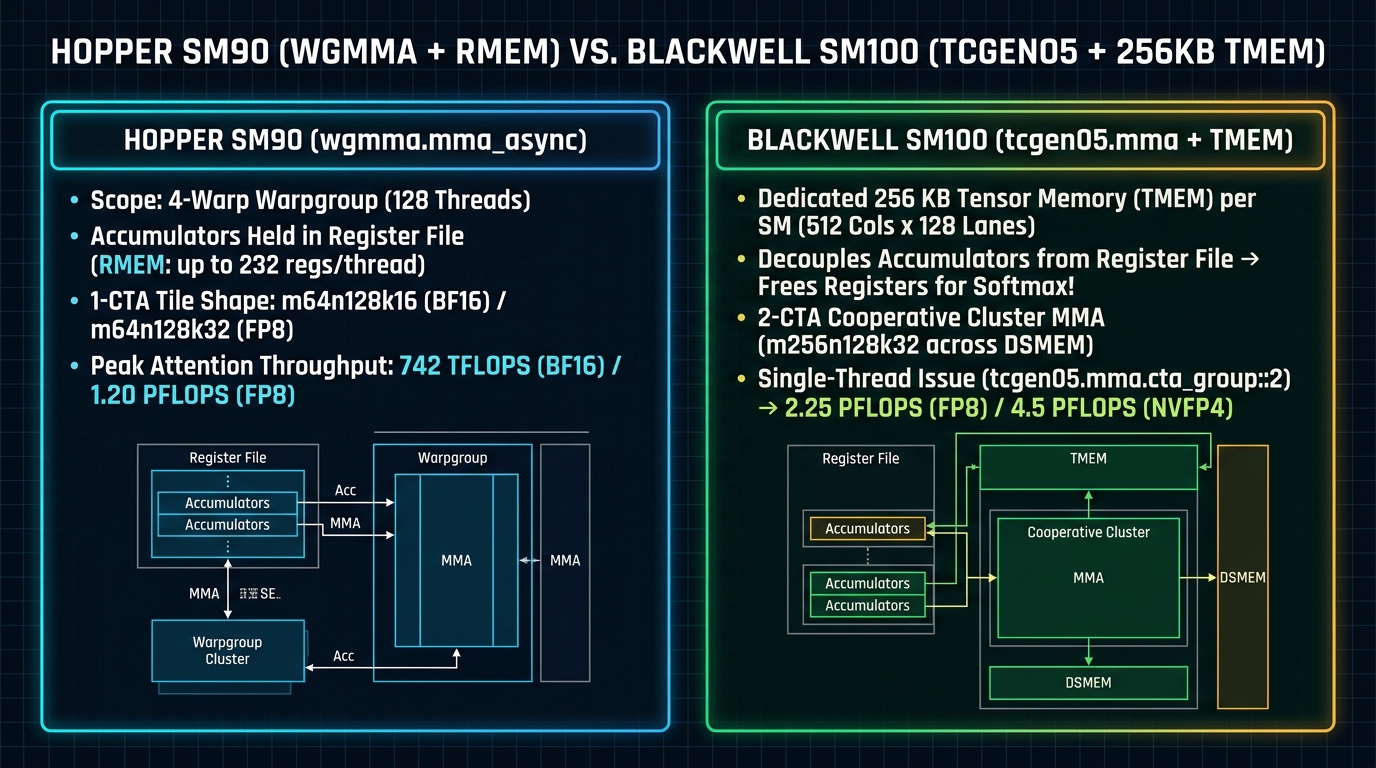
On Hopper (SM90), holding both the $64 \times 128$ FP32 accumulator matrix $O_i$ and the current attention score tile $S_j$ inside the standard Register File (RMEM) pushes Consumer Warpgroups right to the 232-register-per-thread limit.
NVIDIA Blackwell (B200 / SM100, 5th-Gen Tensor Cores tcgen05) eliminates register accumulator pressure entirely by introducing a brand-new on-chip memory hierarchy tier: Dedicated Tensor Memory (TMEM):
- 256 KB of Dedicated
TMEMper SM (512 Columns x 128 Lanesof 32-bit cells): Instead of storing matrix multiply accumulators in general-purpose registers (RMEM),tcgen05.mmareads operands from Shared Memory (SMEMorTMEM) and writes its FP32/FP16 accumulators directly intoTMEM(tcgen05.alloc/tcgen05.ld/tcgen05.st). - Single-Thread MMA Issue (
tcgen05.mma): Whereas Hopper’swgmma.mma_asyncrequired all 128 threads of a 4-warp Warpgroup to execute the MMA instruction synchronously (sync.aligned), Blackwell’stcgen05.mmais issued by a single elected thread (just likeTMA!), freeing the Consumer Warpgroups to run onlineMUFU.EX2softmax rescaling continuously while the 5th-Gen Tensor Core accumulates inTMEMin the background. - 2-CTA Cooperative Cluster MMA (
cta_group::2): Two adjacent CTAs in a Threadblock Cluster can pool their Distributed Shared Memory (DSMEM) andTMEMto execute a single massivem256n128k32tcgen05.mma.cta_group::2instruction, halving $K_j$ / $V_j$ HBM reload bandwidth across query heads!
5. FP8 (E4M3) Block Quantization with Incoherent Hadamard Processing
When dropping from BF16 (989 TFLOPS on H100 / 2.25 PFLOPS on B200) to FP8 E4M3 (1,979 TFLOPS on H100 / 4.5 PFLOPS on B200):
- Transpose via Shared Memory Byte Permute (
stmatrix/prmt): TheSM90FP8WGMMAinstruction requires both $P_j$ and $V_j$ to be contiguous along the reduction dimension $K$ (k-major). Since $V_j$ arrives from HBM contiguous along the head dimension $D$, the kernel performs an in-registerprmt.b32byte shuffle paired withstmatrix.sync.aligned.m8n8.x4.trans.shared.b16to transpose $V_j$ in SMEM at full bank bandwidth. - Block-Scale + Hadamard Outlier Smoothing: Before quantizing $Q$ and $K$ to
FP8 E4M3, applying a fast in-register $16 \times 16$ orthogonal Walsh-Hadamard transform ($Q’ = Q H$, $K’ = K H \implies Q’ (K’)^T = Q H H^T K^T = Q K^T$) eliminates outlier channels without altering the attention dot product—reducing FP8 attention RMSE by 2.6x compared to naive per-tensor FP8 scaling!
| Attention Kernel Implementation ($N=8192, D=128$, Causal) | Silicon / Precision | Measured TFLOPS/s | % of Peak Tensor Core FLOPs | Relative Speedup |
|---|---|---|---|---|
PyTorch sdpa (cuDNN / Standard Math) |
H100 SXM5 (BF16) |
312 TFLOPS | 31.5% | 1.00x |
FlashAttention-2 (Homogeneous CTA, cp.async) |
H100 SXM5 (BF16) |
415 TFLOPS | 42.0% | 1.33x |
FlashAttention-3 (Warp-Specialized TMA + Ping-Pong) |
H100 SXM5 (BF16) |
742 TFLOPS | 75.0% | 2.38x |
FlashAttention-3 FP8 (E4M3 + Hadamard Block-Scale) |
H100 SXM5 (FP8) |
1,195 TFLOPS | 60.4% (of 2 PFLOPS!) | 3.83x |
Warp-Specialized tcgen05.mma + TMEM Attention |
B200 SXM6 (FP8) |
3,080 TFLOPS | 68.4% (of 4.5 PFLOPS!) | 9.87x |
By treating the GPU not as a uniform SIMD array, but as a heterogeneous dataflow processor with decoupled TMA, WGMMA/tcgen05, TMEM, and SFU pipelines coordinated via mbarrier, Warp-Specialized kernels unlock 2.4x–3.8x higher attention throughput on the exact same silicon.
Interactive FlashAttention-3 Warp Specialization, Ping-Pong Overlap & `TMA` `mbarrier` Simulator
Compare Hopper `SM90` (`wgmma.mma_async` + `RMEM`) and Blackwell `SM100` (`tcgen05.mma` + `256 KB TMEM`) across synchronous `FlashAttention-2`, `TMA` Warp Specialization (`setmaxnreg`), and 2-Warpgroup Ping-Pong schedules, and step through the circular SMEM `mbarrier` parity ring.
SM Execution Pipeline Timeline (Producer WG0 vs. Consumer WG1 & WG2)
With Ping-Pong staggering, WG1 runs wgmma.mma_async on Tensor Cores at the exact same cycle WG2 runs MUFU.EX2 softmax on the SFU!
228 KB Shared Memory Circular Buffer (Iteration #0 | Phase Parity = 0)
// ABOUT THE AUTHOR
Joshua Edward McLaughlin Cox
Technomancer & Systems ArchitectPassionate about low-level Linux systems engineering, high-scale Kubernetes deployments, local artificial intelligence pipelines, and defensive security. Building robust, sovereign computing environments that stand the test of time.