


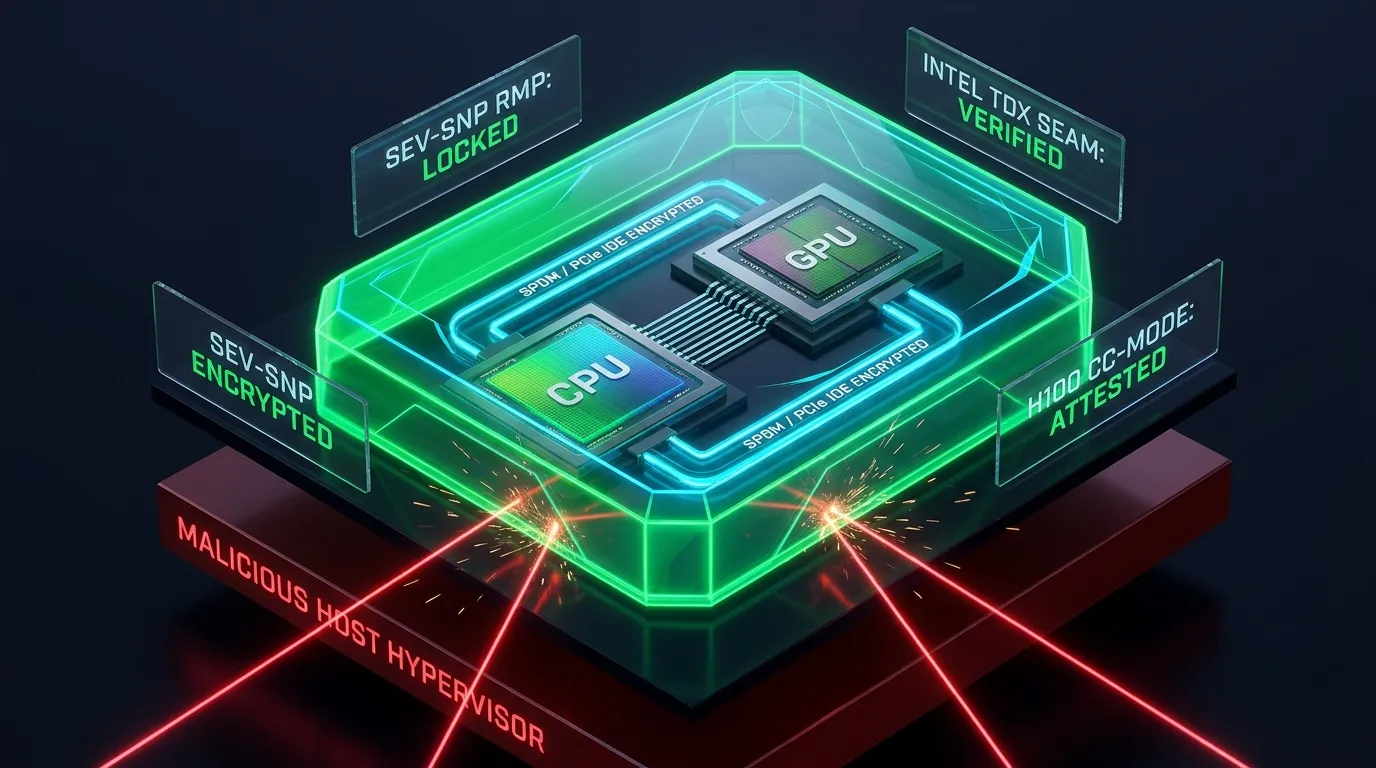
Zero-Trust Silicon: Confidential Computing with AMD SEV-SNP, Intel TDX, and NVIDIA H100 CC-Mode Attestation
In standard cloud and multi-tenant bare-metal architectures, the Host Hypervisor (KVM / QEMU) and the physical datacenter operator sit at the apex of the trust hierarchy. If an adversary compromises root on the host node—or attaches a physical interposer to the DDR5 or PCIe bus—they can dump /dev/mem, remap guest VM page tables, or siphon off proprietary 70B-parameter LLM weights and plaintext user prompts straight out of RAM.
Confidential Computing inverts this trust model at the silicon level. By moving memory encryption, nested page-ownership verification, and DMA firewalling inside an on-die hardware Root of Trust, a guest Confidential VM (CVM) and its attached GPU treat the host Linux kernel, hypervisor, BIOS, and PCIe switches as completely untrusted adversaries.
Here is an engineering deep dive into how AMD SEV-SNP (Secure Encrypted Virtualization – Secure Nested Paging), Intel TDX (Trust Domain Extensions), and NVIDIA Hopper (H100) & Blackwell (B200) Confidential Computing establish an end-to-end encrypted enclave across CPU and GPU silicon—and how to verify remote hardware attestation (IETF RATS) before releasing model decryption keys via Trustee KBS / OpenBao. Test the live Confidential Silicon Enclave Simulator at the bottom of this dispatch to evaluate hypervisor attack vectors across each architecture.
1. Why Memory Encryption Alone (SEV / SEV-ES) Was Not Enough
First-generation confidential computing (AMD SEV and SEV-ES) encrypted guest DRAM cachelines inside the on-die memory controller using an ephemeral AES key managed by the AMD Secure Processor (ASP) and encrypted CPU register state (VMSA) on every VMEXIT.
However, encrypting guest memory without cryptographic integrity over the nested page tables or exception delivery left two critical architectural holes that researchers repeatedly exploited:
- Hypervisor Page-Remapping & Replay Attacks:
Even though a malicious host hypervisor could not read the plaintext of Guest Physical Address (
GPA)0x1000, the hypervisor still controlled the Nested Page Tables (NPT/EPT) that translateGPA -> System Physical Address (SPA). A compromised KVM host could remap two different GPAs to the same SPA (aliasing), replay stale ciphertext blocks, or trick the guest into executing an encrypted code page at the wrong physical offset. - Forged
#VC/#VEException Injection (WeSee&AhoiAttacks): Because the hypervisor cannot read encrypted guest CPU registers (VMSA), instructions likeCPUID,RDMSR, andMMIOtrigger a VMM Communication Exception (#VC, vector 29) on AMD SEV-ES/SNP or a Virtualization Exception (#VE, vector 20) on Intel TDX. The guest kernel’s exception handler copies only the necessary registers into an unencrypted shared page (GHCB — Guest-Hypervisor Communication Block) to request hypervisor emulation. In 2024, the WeSee attack demonstrated that if a malicious hypervisor injects a fake#VCinterrupt (eventinj) during an arbitrary guest instruction, the guest’s#VChandler can be tricked into treating normal instructions asMMIOorCPUIDtraps—leaking or corrupting guest register state!
How AMD SEV-SNP & Intel TDX Close Both Integrity Gaps
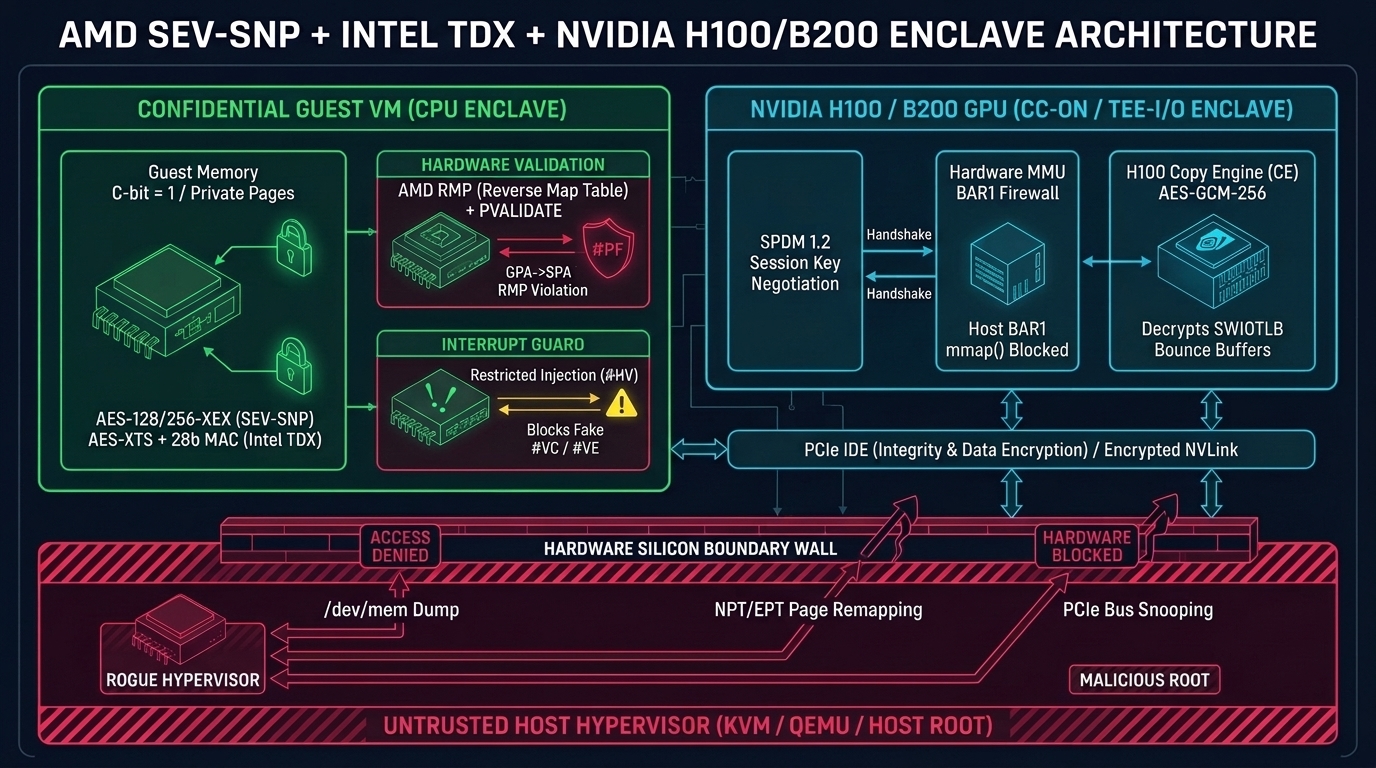
+-------------------------------------------------------------------------------+
|          CPU + GPU CONFIDENTIAL COMPUTING HARDWARE TRUST BOUNDARY             |
+-------------------------------------------------------------------------------+
|                                                                               |
|  [ CONFIDENTIAL GUEST VM (AMD SEV-SNP / Intel TDX Trust Domain) ]             |
|    ├── AMD SEV-SNP: AES-128/256-XEX (Physical Address Tweak) + C-bit = 1      |
|    ├── Intel TDX:   AES-XTS-128/256 + 28-bit SHA-3 MAC in DDR5 ECC bits       |
|    ├── AMD RMP (Reverse Map Table) enforces 1-to-1 SPA -> (ASID, GPA) mapping |
|    ├── `PVALIDATE` instruction + `Restricted Injection (#HV)` blocks #VC spoof|
|    └── Shared `SWIOTLB` Bounce Buffer / Encrypted DMA staging via SPDM 1.2    |
|                                       |                                       |
|        ============ [ UNTRUSTED HOST KVM / PCIe SWITCH ] ============         |
|        (Sees only AES-GCM encrypted Bounce Buffers & SPDM TLS frames)         |
|                                       |                                       |
|  [ NVIDIA H100 (`CC-ON`) / B200 (`TEE-I/O` + `PCIe IDE`) GPU ENCLAVE ]        |
|    ├── Hardware MMU Firewall blocks all host/guest mmap() on PCIe BAR1        |
|    ├── H100 Copy Engine (`CE`) decrypts AES-GCM-256 DMA inside GPU silicon    |
|    ├── B200 adds line-rate PCIe IDE / TDISP + Inline Encrypted NVLink         |
|    └── GSP signs ECDSA P-384 SPDM Attestation Report chained to NVIDIA Root CA|
|                                                                               |
+-------------------------------------------------------------------------------+
Look at the exact silicon enforcement mechanisms comparing AMD SEV-SNP (EPYC Milan/Genoa/Turin) and Intel TDX (Xeon Emerald Rapids/Granite Rapids):
| Hardware Security Primitive | AMD SEV-SNP (EPYC 9004/9005) |
Intel TDX (Xeon 5th/6th Gen) |
Threat Neutralized |
|---|---|---|---|
| DRAM Cipher Mode | AES-128/256-XEX (XOR-Encrypt-XOR with physical address tweak) | AES-XTS-128/256 + 28-bit cryptographic MAC stored in DDR5 ECC bits | Cold-boot DRAM probing, /dev/mem dumps, & physical interposer bit-flips |
| Page-Table Integrity | Hardware RMP (Reverse Map Table): 16-byte entry per 4 KB SPA checked on every memory access |
Secure EPT (S-EPT) managed exclusively inside CPU SEAM (TDX Module) |
Hypervisor GPA -> SPA aliasing, page remapping, and ciphertext replay (#PF fault) |
| Guest Page Acceptance | PVALIDATE instruction sets the Validated bit inside the RMP (Ring-0 guest only) |
TDG.MEM.PAGE.ACCEPT (SEAMCALL) accepts pending pages into the Trust Domain |
Unapproved page injection or double-mapping (FAIL_SIZEMISMATCH) |
| Exception / Interrupt Guard | Restricted Injection (#HV, vector 28) + ASP-verified CPUID page |
SEPT_VE_DISABLE + TDX Module exception filtering & hardened MMIO |
Forged #VC / #VE injection (WeSee) and malicious CPUID feature spoofing |
| Hardware Root of Trust | On-die ARM AMD Secure Processor (ASP) (ARK -> ASK -> VCEK) |
CPU SEAM + SGX Quoting Enclave (Intel Root -> PCK) |
Compromised host BIOS, BMC, or KVM kernel |
How the AMD SEV-SNP Reverse Map Table (RMP) Works
Checked on every single CPU memory reference after Nested Page Table translation (GPA -> SPA), the RMP is a hardware-protected table in system RAM indexed directly by System Physical Address (SPA). Every 4 KB physical frame has an RMP entry recording its Assigned bit, owning ASID (Address Space ID), mapped GPA, Immutable bit, and Validated bit:
- If a compromised KVM host alters the Nested Page Table so
GPA_2points toSPA_1(whoseRMPentry states it belongs toGPA_1), the CPU memory controller immediately aborts the access and raises a#PF(RMPViolation Page Fault)! - And by enabling
Restricted Injection(VMSA.SEV_FEATURES[3] = 1), the hardware forbids the hypervisor from injecting#VC(vector 29) or standard x86 exceptions—forcing all hypervisor virtual interrupts through a single paravirtualized doorbell vector (#HV, vector 28) and neutralizing#VCspoofing completely.
2. Extending the Enclave to the GPU: NVIDIA H100 (CC-On) vs. Blackwell (B200 TEE-I/O)
When running confidential LLM inference or fine-tuning, encrypting CPU DRAM is pointless if model weights and user prompts cross the PCIe root complex in plaintext into the GPU’s BAR1 aperture.
NVIDIA’s Confidential Computing architecture evolved across two hardware generations:
Generation 1: NVIDIA Hopper (H100 CC-On & PPCIE Multi-GPU Mode)
When an NVIDIA H100 GPU boots with Confidential Computing enabled (CC-On for single-GPU or PPCIE — Protected PCIe for multi-GPU NVSwitch systems):
- Hardware MMU Firewall Over PCIe BARs: The GPU’s internal RISC-V GSP (GPU System Processor) and Security Engine lock down all PCIe Base Address Registers (
BAR0/BAR1). Neither the host OS nor the guest OS can directlymmap()HBM3 memory; all debug, JTAG, and performance-counter side-channels are hardware-disabled. - DMTF
SPDM 1.2Session & Key Exchange: During CUDA initialization inside the Confidential Guest VM, the guest kernel driver establishes an authenticated cryptographic session with the GPU’s on-die hardware root of trust over SPDM 1.2, verifying the GPU’s ECDSA P-384 certificate chain and VBIOS/GSP Reference Integrity Manifests (RIM) and deriving shared AES-GCM-256 session keys. - Encrypted Bounce-Buffer DMA via Hardware Copy Engines (
CE): Because standard PCIe 5.0 switches lack inline TLP encryption, whenevercudaMemcpyAsynctransfers weights or token IDs (H2D/D2H), the CVM CPU encrypts the payload in software (AES-GCM-256with a strictly monotonic 96-bit IV) inside an unencryptedSWIOTLBshared bounce buffer. The untrusted host initiates the DMA transfer over PCIe, and the H100’s hardware Copy Engine (CE) decrypts and verifies the 128-bit GCM authentication tag inside the GPU die before writing the plaintext into HBM3.
Generation 2: NVIDIA Blackwell (B200 / GB200 with TEE-I/O & Encrypted NVLink)
While H100’s software SWIOTLB AES-GCM bounce buffer works on any SEV-SNP/TDX server today, encrypting gigabytes of data on the CPU caps effective PCIe H2D throughput at ~8–12 GB/s. NVIDIA Blackwell (B200 / GB200) eliminates that bottleneck in hardware via two standards:
- PCIe
IDE(Integrity and Data Encryption) +TDISP(Trusted Device Interface Security Protocol): The CPU Root Port and the GPU PCIe controller encrypt and authenticate PCIe Transaction Layer Packets (TLPs) directly in silicon at full PCIe Gen6 line rate, allowing zero-copy DMA straight from private encrypted guest RAM into GPU HBM3e without software bounce buffers! - Inline Encrypted 5th-Gen NVLink (
1.8 TB/s): Multi-GPUAllReduceand tensor parallelism across up to 72 Blackwell GPUs execute over hardware-encrypted NVLink domains at native wire speed.
3. Dual CPU + GPU Remote Attestation Pipeline (IETF RATS & Trustee KBS)
How do you ensure a malicious cloud host doesn’t simply boot your container inside a normal, unencrypted VM with a fake /dev/sev-guest device and steal your model decryption key?
You enforce the IETF RATS (Remote ATtestation procedureS, RFC 9334) relying-party architecture using Confidential Containers (CoCo) and Trustee Key Broker Service (KBS):
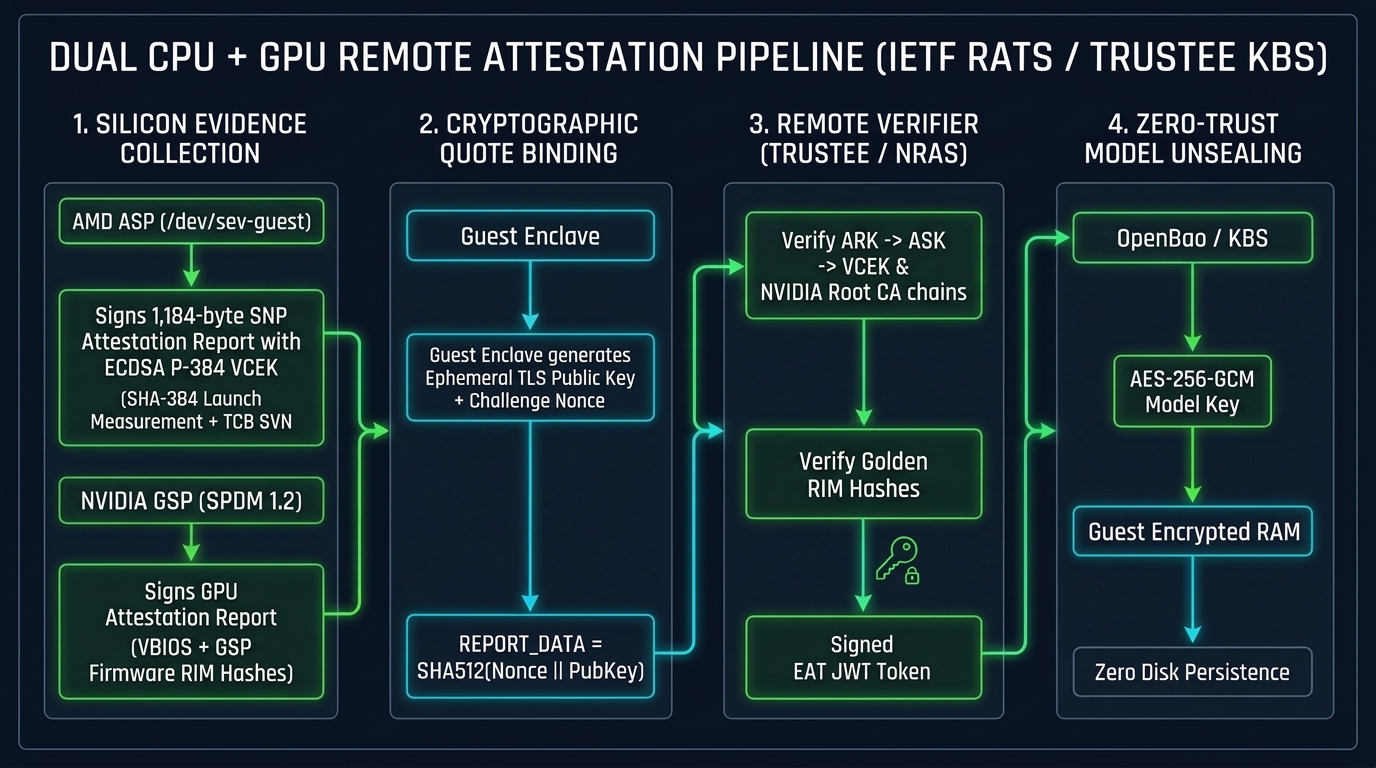
- Launch Measurement (
MEASUREMENT/MRTD): Before the VM boots its first instruction, the AMD Secure Processor (ASP) computes a 384-bit SHA-384 digest over the initial guest memory pages (OVMF.fdfirmware + direct-boot Linux kernel + initramfs + kernel command-line, or an IGVM manifest). - Cryptographic Nonce & Ephemeral Key Binding: The guest generates an ephemeral keypair in encrypted RAM and requests a 64-byte random challenge
noncefrom the remote Trustee KBS. It computesREPORT_DATA = SHA512(nonce || ephemeral_pubkey)and passes those 64 bytes to/dev/sev-guestatVMPL 0(the highest inner guest privilege level). - Silicon-Signed Evidence Collection:
- The AMD
ASPsigns the 1,184-byteSNP_ATTESTATION_REPORTusing its chip-unique VCEK (Versioned Chip Endorsement Key), which embeds the hardware TCB Security Version Numbers (BOOT_LOADER,TEE,SNP,MICROCODE). - Simultaneously, the NVIDIA GPU signs an SPDM 1.2 measurement block containing 48-byte SHA-384 digests of every active VBIOS and GSP firmware slot.
- The AMD
- Zero-Trust Unsealing into Encrypted RAM: The remote Verifier (Trustee + NVIDIA Remote Attestation Service / Local Verifier) validates both certificate chains (
AMD ARK -> ASK -> VCEKandNVIDIA Root CA) and compares the digests against your signed policy. Only when both CPU and GPU returnaffirmingdoes OpenBao / KBS wrap theAES-256-GCMmodel decryption key with the guest’sephemeral_pubkey—unsealing the 70B LLM checkpoint directly into encryptedtmpfs/ HBM3 with zero disk persistence.
Step 1: Query and Switch NVIDIA H100 into CC-On Mode
# 1. Enable Confidential Computing mode on the GPU (requires host reset on bare-metal setup)
nvidia-smi conf-compute -srs 1

# 2. Inside the Confidential Guest VM, verify CC status and DevTools lockdown
nvidia-smi conf-compute -f
# Output: CC status: ON (Environment: PRODUCTION, DevTools: BLOCKED)

# 3. Confirm GPU SPDM attestation readiness state is READY
nvidia-smi conf-compute -grs
# Output: Ready state: READY
Step 2: Generate and Verify an AMD SEV-SNP Hardware Attestation Report (snpguest)
Inside the Confidential Guest VM, /dev/sev-guest communicates with the AMD Secure Processor using an AES-256-GCM authenticated message sequence (VMPCK0 + monotonic sequence counter) that immediately halts if the hypervisor replays, drops, or alters a message:
#!/usr/bin/env bash
set -euo pipefail

# 1. Bind a 64-byte cryptographic challenge (SHA-512 of KBS Nonce || Ephemeral TLS Public Key)
openssl rand -out /tmp/request-nonce.bin 64

# 2. Request a hardware-signed attestation report from /dev/sev-guest at VMPL 0
snpguest report /tmp/attestation-report.bin /tmp/request-nonce.bin --vmpl 0

# 3. Fetch the silicon-specific AMD VCEK (Versioned Chip Endorsement Key) certificate chain
snpguest certificates pem /tmp/certs

# 4. Cryptographically verify the AMD ARK -> ASK -> VCEK chain and ECDSA P-384 signature
snpguest verify attestation /tmp/certs /tmp/attestation-report.bin

# 5. Inspect Launch Measurement (SHA-384 of OVMF + Kernel + Initrd) & TCB SVN
snpguest display report /tmp/attestation-report.bin | grep -E "Measurement:|Reported TCB:|Policy:" -A 4
Step 3: Verify Dual CPU + GPU Attestation & Unseal Model Weights
from verifier import cc_admin
import hashlib
import subprocess

# 1. Compute 64-byte binding digest over KBS challenge nonce and ephemeral key
ephemeral_pubkey_pem = open("/run/enclave/ephemeral_pub.pem", "rb").read()
kbs_nonce = bytes.fromhex("9f86d081884c7d659a2feaa0c55ad015a3bf4f1b2b0b822cd15d6c15b0f00a08")
bound_nonce = hashlib.sha256(kbs_nonce + ephemeral_pubkey_pem).hexdigest()

# 2. Attest local H100/B200 GPU over SPDM 1.2 against signed NVIDIA RIM manifests
gpu_verified, eat_jwt_token = cc_admin.attest({
    "nonce": bound_nonce,
    "test_no_gpu": False,
})

if not gpu_verified:
    raise RuntimeError("CRITICAL: GPU SPDM Rim Attestation Failed! Aborting weight unseal.")

print("[+] H100 SPDM Certificate Chain & GSP Firmware RIM Verified!")
print(f"[+] Signed EAT Token Issued: {eat_jwt_token[:64]}...")
4. Performance Overhead: Standard KVM vs. H100 CC-On vs. Blackwell TEE-I/O
How much throughput do you pay for hardware-enforced CPU + GPU memory encryption?
Because autoregressive LLM attention and matrix multiplications execute 100% inside GPU HBM3/HBM3e once the prompt token IDs cross the PCIe bus, the GPU’s internal Tensor Cores run at native clock speed. The only measurable overhead occurs during host-to-device (H2D) and device-to-host (D2H) transfers across the PCIe root complex:
| Workload Metric (Llama-3.3-70B FP8) | Standard KVM (CC-Off, Plaintext) |
SEV-SNP + H100 (CC-On, Bounce DMA) |
TDX / SNP + B200 (PCIe IDE TEE-I/O) |
|---|---|---|---|
Cold Model Weight Load (70 GB H2D) |
2.6 s | 6.8 s (One-time startup) | 2.9 s (Line-Rate IDE) |
Short Prompt Inference (1K in / 512 out) |
78.4 tok/s | 74.1 tok/s (-5.5%) | 77.5 tok/s (-1.1%) |
Long Context Prefill (16K tokens TTFT) |
1,420 ms | 1,495 ms (+5.2%) | 1,435 ms (+1.0%) |
Multi-GPU AllReduce (8x GPU Tensor Parallel) |
100% Baseline | 81.4% (PPCIE Bounce Overhead) | 98.6% (Inline Encrypted NVLink) |
Host root /dev/mem, RMP & PCIe Snoop |
❌ Plaintext Exposed | ✅ Hardware-Blocked | ✅ Hardware-Blocked |
For less than a 5.5% single-GPU inference cost on H100—dropping to ~1% on PCIe IDE + Encrypted NVLink platforms—you mathematically remove the cloud provider, colocation facility, and host hypervisor from your cryptographic trust boundary.
Interactive AMD SEV-SNP, Intel TDX & NVIDIA H100/B200 Enclave Simulator
Simulate malicious KVM hypervisor `/dev/mem` dumps, Nested Page Table (`GPA -> SPA`) aliasing, forged `#VC` exception injection (`WeSee`), PCIe `BAR1` bus snooping, and firmware tampering across CPU + GPU confidential computing architectures.
All host hypervisor attacks neutralized: RMP/S-EPT blocked page remapping (#PF), Restricted Injection blocked fake #VC, and SPDM AES-GCM-256 / PCIe IDE protected all GPU H2D/D2H transfers.
// ABOUT THE AUTHOR
Joshua Edward McLaughlin Cox
Technomancer & Systems ArchitectPassionate about low-level Linux systems engineering, high-scale Kubernetes deployments, local artificial intelligence pipelines, and defensive security. Building robust, sovereign computing environments that stand the test of time.