



Secret Zero on Bare-Metal Kubernetes: TPM 2.0 Hardware Attestation with SPIFFE/SPIRE and OpenBao
In cloud-managed Kubernetes environments (EKS, GKE, AKS), operators take workload identity for granted: the cloud provider’s hypervisor injects a signed instance metadata document (IMDSv2 / GCP Metadata Server) into the virtual machine, allowing nodes and pods to trade projected tokens for secrets in AWS Secrets Manager or GCP Secret Manager.
When you run sovereign bare-metal Kubernetes clusters—such as our Talos Linux, Cilium, and Rook-Ceph architecture or Vigilant Octo Waffle—there is no cloud hypervisor. You immediately confront the foundational infrastructure security paradox known as The Secret Zero Problem (“The Bottom Turtle”):
To fetch secrets from OpenBao (or HashiCorp Vault), a Kubernetes node or pod needs an initial authentication token. Where do you store that bootstrap token without hardcoding it on an NVMe disk, embedding it inside a GitOps repo, or baking it into a PXE/iPXE boot image where a physical or network attacker can steal it?
The answer sits soldered directly onto your server’s motherboard over the SPI/LPC bus: the Trusted Platform Module (TPM 2.0) cryptoprocessor.
Here is the complete production blueprint for eliminating static bootstrap secrets on bare-metal Kubernetes by chaining TPM 2.0 hardware node attestation (TPM2_ActivateCredential + Measured Boot PCRs), SPIFFE/SPIRE cryptographic workload identities, and OpenBao. Experiment with the live Silicon Root of Trust Attestation Simulator embedded at the bottom of this dispatch to test fault injection across the chain.
1. The Hardware-Rooted Chain of Trust
Every enterprise 1U/2U server and modern edge compute node ships with a discrete or firmware TPM 2.0 cryptoprocessor compliant with the ISO/IEC 11889 specification. Inside its tamper-resistant silicon sits a factory-burned Endorsement Key (EK) at non-volatile hierarchy handle 0x81010001 whose private key material is generated inside the chip and can mathematically never be exported.
By anchoring SPIRE (the SPIFFE Runtime Environment) to the TPM 2.0 Endorsement Key and OpenBao (the Linux Foundation’s open-source fork of Vault) to SPIRE’s cryptographic trust bundle, we establish an unbroken, zero-secret chain of trust from physical silicon to application RAM:
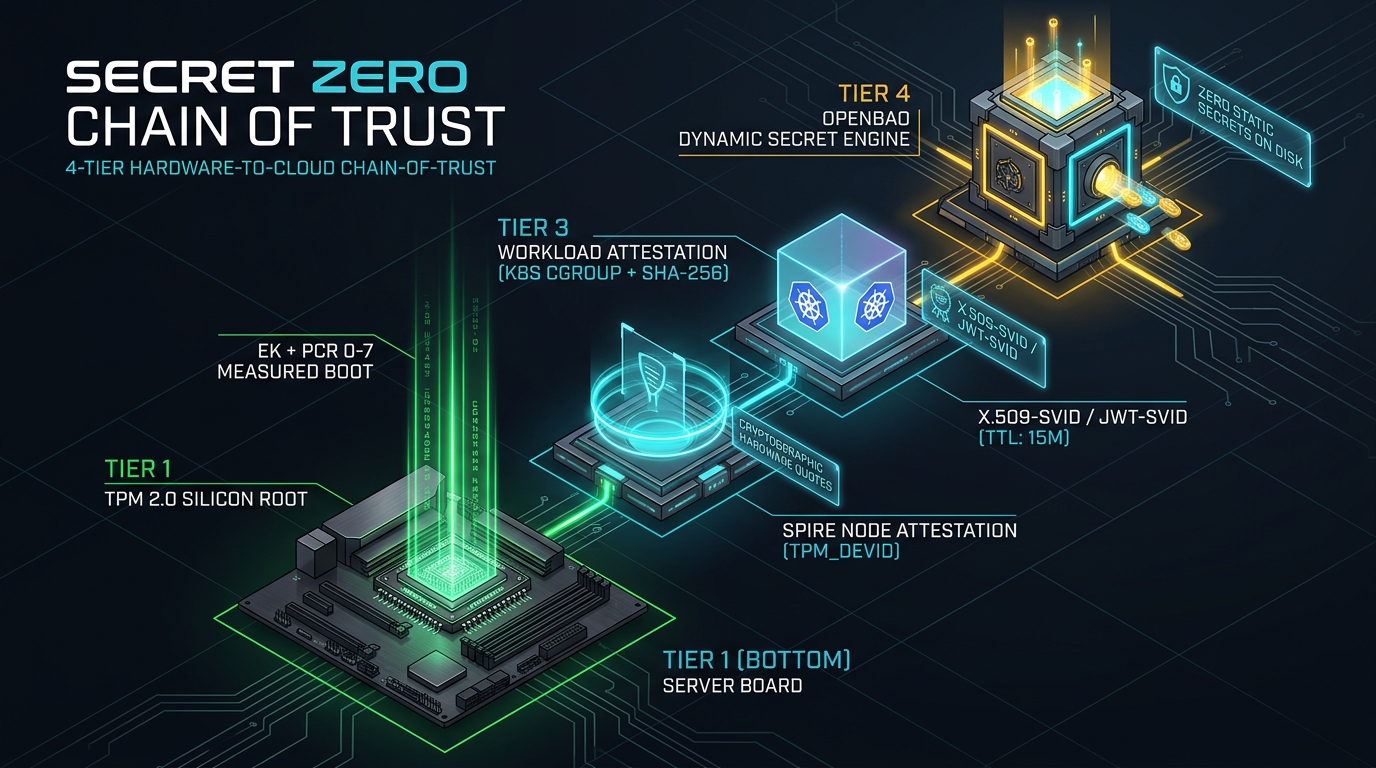
+-------------------------------------------------------------------------------+
|          TPM 2.0 -> SPIFFE/SPIRE -> OPENBAO ZERO-SECRET ARCHITECTURE          |
+-------------------------------------------------------------------------------+
|                                                                               |
|  1. SILICON ROOT OF TRUST (Motherboard TPM 2.0 / /dev/tpmrm0)                 |
|     ├── Factory Endorsement Key (EK @ 0x81010001) + Manufacturer EK Cert      |
|     ├── Attestation Key (AK / LDevID) restricted to signing internal quotes   |
|     └── SHA-256 PCR Bank (PCR 0, 2, 4, 7) measuring UEFI, Secure Boot & UKI   |
|                                       |                                       |
|                   TPM2_ActivateCredential + TPM2_Quote Challenge              |
|                                       v                                       |
|  2. NODE ATTESTATION (SPIRE Agent <-> SPIRE Server tpm_devid Plugin)          |
|     ├── Verifies EK/DevID certificate chain against Hardware Inventory CA     |
|     ├── VerifiesAK residency inside EK's TPM via encrypted credential blob    |
|     └── Issues Node SVID: spiffe://tekromancy.internal/spire/agent/tpm/...    |
|                                       |                                       |
|                   Linux Kernel cgroup PID + Kubelet Container SHA-256         |
|                                       v                                       |
|  3. WORKLOAD ATTESTATION (SPIRE CSI Driver tmpfs -> Application Pod)          |
|     ├── Inspects caller socket PID -> cgroup -> ContainerID -> Image Digest   |
|     ├── Mints short-lived (15m) X.509-SVID & (5m) JWT-SVID into RAM tmpfs     |
|     └── Identity: spiffe://tekromancy.internal/ns/prod/sa/payment-engine      |
|                                       |                                       |
|                   OIDC JWT-SVID / mTLS Cert Auth (Zero Static Tokens!)        |
|                                       v                                       |
|  4. DYNAMIC SECRET ENGINE (OpenBao Cluster)                                   |
|     ├── Validates JWT-SVID signature via SPIRE OIDC Discovery Bundle          |
|     └── Synthesizes ephemeral 15m PostgreSQL / Ceph RGW S3 credentials        |
|                                                                               |
+-------------------------------------------------------------------------------+
Why Software-Only Bootstrap Tokens Fail on Bare Metal
Before diving into the TPM 2.0 implementation, consider what happens under three realistic datacenter and edge threat models when a cluster relies on traditional software bootstrap tokens (such as static kubeadm join tokens, long-lived Vault AppRole secret_id files, or unencrypted disk keys):
- Network PXE / iPXE Interception: A rogue workload or VLAN intruder sends a DHCP/TFTP request to the provisioning server and downloads the unattended OS image or cloud-init/ign config containing the bootstrap secret.
- Physical NVMe Drive Theft / Decommissioning Leak: A drive fails or is pulled from a colocation rack. An attacker mounts the NVMe drive on another server and extracts
/var/lib/kubelet/pkior/etc/vault/approle-secret-id. - Evil Maid / Live-USB Boot Tampering: Someone with temporary crash-cart or IPMI virtual-media access boots a live Linux ISO or edits the kernel command line (
init=/bin/sh) to dump secrets while masquerading as the production node.
Chaining TPM 2.0 EK/AK residency proofs with Measured Boot PCR quotes neutralizes all three attacks simultaneously.
2. Provisioning TPM 2.0 DevID & Measured Boot PCRs
A critical nuance of the TPM 2.0 specification is privacy separation: to prevent arbitrary software from using the factory Endorsement Key (EK) as a global tracking super-cookie, the TPM 2.0 hardware architecture marks the EK as a decrypt-only storage parent (TPMA_OBJECT_DECRYPT | TPMA_OBJECT_RESTRICTED). The EK cannot directly sign PCR quotes or general data.
Instead, the TPM generates a restricted signing child key—either an Attestation Key (AK) or an IEEE 802.1AR Initial/Local Device Identifier (IDevID / LDevID)—whose private key is cryptographically wrapped by the EK.
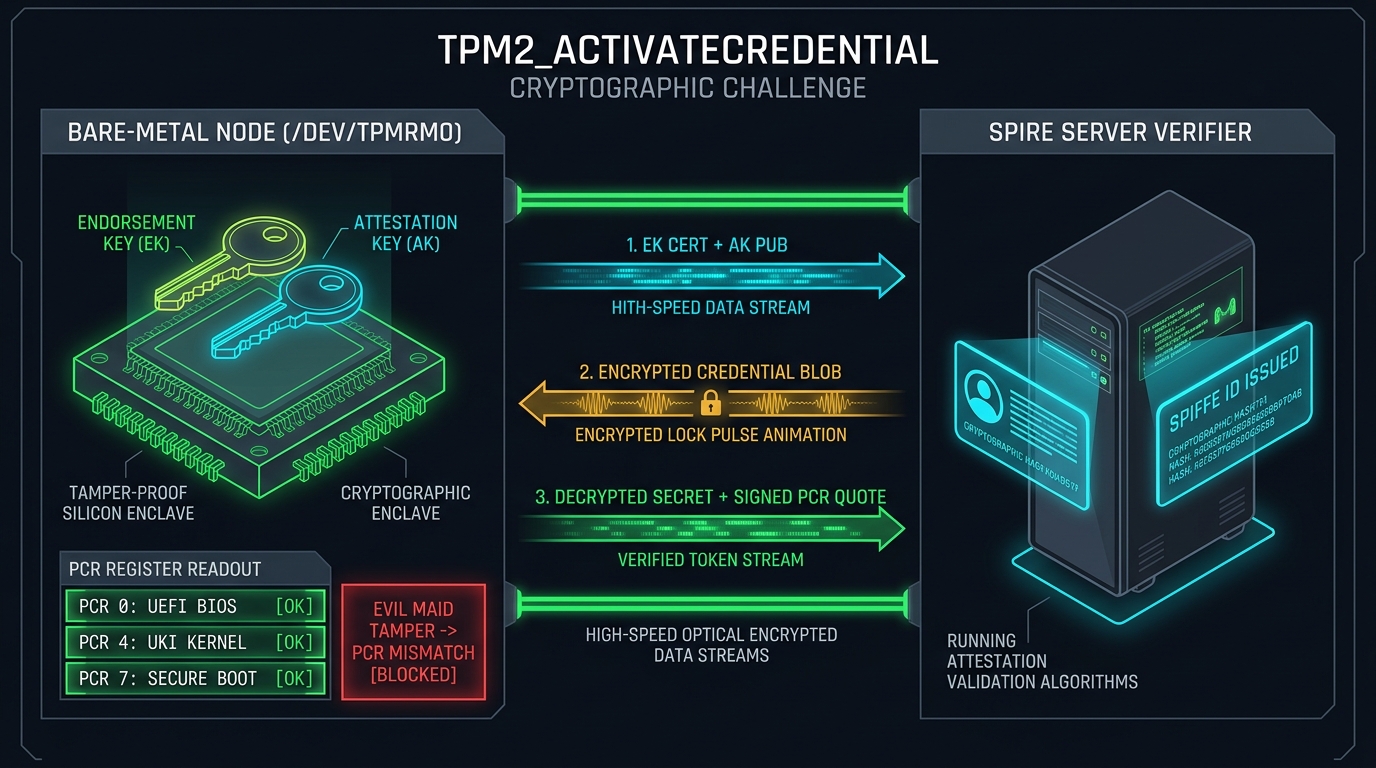
How TPM2_ActivateCredential Proves Hardware Residency
How does the remote SPIRE Server verify that an Attestation Key (AK) actually lives inside the genuine TPM 2.0 chip represented by the manufacturer’s EK certificate, rather than being forged in software by an attacker who merely copied the public EK cert?
Through the two-step TPM2_MakeCredential / TPM2_ActivateCredential cryptographic protocol:
$$\text{Challenge Blob} = \text{Encrypt}{\text{EK}{\text{pub}}}\Big(\text{Secret}{\text{nonce}} ;\parallel; \text{HMAC}\big(\text{Name}(\text{AK}{\text{pub}})\big)\Big)$$
- Enrollment / Attestation Request: The SPIRE Agent on the worker node sends the SPIRE Server its factory
EKpublic certificate (0x01c00002), itsDevID/AKpublic template, and a certifying structure (TPM2_Certify). - Server Challenge (
MakeCredential): The SPIRE Server validates theEKcertificate against the silicon vendor’s root CA (Infineon, STM, Nuvoton, Intel PTT, or AMD fTPM) and our internal Hardware Inventory CA. It then generates a random symmetric challenge secret and wraps it using theEKpublic key, cryptographically binding the wrapper to the exact cryptographicName(SHA-256 hash of the public area and attributes, includingfixedTPM=1andsensitiveDataOrigin=1) of theAK. - Silicon Activation (
TPM2_ActivateCredential): The SPIRE Agent passes the encrypted blob into/dev/tpmrm0. The TPM 2.0 chip uses its non-exportableEKprivate key to decrypt the outer wrapper, internally verifies that the loadedAKhandle matches the boundNameinside the same silicon, and only then releases the decrypted challenge secret back to the SPIRE Agent.
Measured Boot & The Golden PCR Bank
Simultaneously, from the first CPU instruction after reset (CRTM), the system firmware and bootloader measure every executable stage into the TPM’s Platform Configuration Registers (PCRs).
Unlike normal CPU registers that can be overwritten (MOV), a TPM PCR can only be mutated via the irreversible TPM2_PCR_Extend operation:
$$\text{PCR}{\text{new}}[i] = \text{SHA-256}\Big(\text{PCR}{\text{old}}[i] ;\parallel; \text{SHA-256}(\text{Component})\Big)$$
Because SHA-256 is preimage-resistant, no operating system compromise after boot can “roll back” or forge a valid PCR value if an unauthorized bootloader or kernel parameter was loaded earlier in the boot sequence:
| PCR Index | TCG Measured Component | Security Guarantee & Tamper Detection |
|---|---|---|
PCR 0 |
Core System Firmware (SRTM, UEFI BIOS) |
Detects SPI flash rootkits (e.g., LoJax, MoonBounce) or unauthorized BIOS downgrades. |
PCR 2 |
Extended / Option ROM Code | Detects malicious PCIe NIC, HBA, or GPU Option ROM firmware injection. |
PCR 4 |
UEFI Boot Manager & Unified Kernel Image (UKI) |
Detects live-USB booting, kernel substitution, or initramfs tampering (such as Talos vmlinuz / squashfs edits). |
PCR 7 |
Secure Boot Policy (PK, KEK, db, dbx) |
Detects disabling Secure Boot in BIOS or enrolling rogue MOK/platform signing keys. |
PCR 11 |
Unified Kernel Image (systemd-stub) Phase Measurements |
Binds disk decryption and node identity to specific boot phases (enter-initrd vs. ready). |
Provisioning Script: Extracting EK & Provisioning a TPM 2.0 LDevID
During initial server burn-in inside an isolated provisioning VLAN, run the following script using tpm2-tools (>= 5.5) to extract the factory Endorsement Key certificate, generate a hardware-bound LDevID keypair inside /dev/tpmrm0, and sign its CSR with your internal Hardware Inventory CA:
#!/usr/bin/env bash
set -euo pipefail

umask 0077
mkdir -p /etc/spire/agent/tpm
cd /etc/spire/agent/tpm

# 1. Extract the factory RSA-2048 or ECC-P256 Endorsement Key Certificate from TPM NVRAM
tpm2_getekcertificate -T device:/dev/tpmrm0 -o ek-cert.der
openssl x509 -inform DER -in ek-cert.der -out ek-cert.pem

echo "[+] Verified TPM 2.0 Manufacturer EK Certificate:"
openssl x509 -in ek-cert.pem -noout -issuer -subject -serial -fingerprint -sha256

# 2. Create the Primary Endorsement Key context at persistent handle 0x81010001
tpm2_createprimary -C e -g sha256 -G rsa2048 -c ek.ctx
tpm2_evictcontrol -C o -c ek.ctx 0x81010001 || true

# 3. Generate a restricted, non-migratable LDevID signing key under the Storage Hierarchy
#    Attributes: fixedtpm|fixedparent|sensitivedataorigin|userwithauth|sign
tpm2_createprimary -C o -g sha256 -G ecc256 -c srk.ctx
tpm2_create \
  -C srk.ctx \
  -g sha256 \
  -G rsa2048:rsassa:null \
  -a "fixedtpm|fixedparent|sensitivedataorigin|userwithauth|sign" \
  -u devid-pub.blob \
  -r devid-priv.blob

# 4. Load the LDevID into the TPM and generate an X.509 CSR via tpm2-openssl provider
tpm2_load -C srk.ctx -u devid-pub.blob -r devid-priv.blob -c devid.ctx
tpm2_evictcontrol -C o -c devid.ctx 0x81020001

NODE_HOSTNAME=$(hostname -f)
openssl req -provider tpm2 -provider default \
  -new -key handle:0x81020001 \
  -subj "/O=Tekromancy Sovereign Infrastructure/CN=${NODE_HOSTNAME}/serialNumber=$(cat /sys/class/dmi/id/product_uuid)" \
  -out devid.csr

# 5. Record the golden SHA-256 Measured Boot PCR baseline for SPIRE Server policy
tpm2_pcrread sha256:0,2,4,7 -o pcr-golden.bin
sha256sum pcr-golden.bin > pcr-golden.sha256
Once the provisioning CA signs devid.csr into /etc/spire/agent/tpm/devid.crt, even if an attacker steals /etc/spire/agent/tpm/devid-priv.blob off the disk, that file is useless: devid-priv.blob is encrypted by the TPM’s internal Storage Root Key (SRK) seed, which only exists inside that specific physical motherboard’s TPM 2.0 silicon.
3. Configuring SPIRE Server & Agent with the tpm_devid Plugin
Instead of ever running spire-server token generate, we configure the SPIRE Server and SPIRE Agent to use the built-in tpm_devid NodeAttestor plugin.
SPIRE Server Configuration (/etc/spire/server/server.conf)
In production, the SPIRE Server itself can back its Upstream Authority or root signing keys with a hardware HSM or TPM, while validating worker node LDevID and EK certificates against your pinned CA bundles:
# /etc/spire/server/server.conf
server {
    bind_address = "0.0.0.0"
    bind_port = "8081"
    trust_domain = "tekromancy.internal"
    data_dir = "/var/lib/spire/server"
    log_level = "INFO"
    ca_ttl = "24h"
    default_x509_svid_ttl = "15m"
    default_jwt_svid_ttl = "5m"
    ca_subject = {
        country = ["US"],
        organization = ["Tekromancy Sovereign Mesh"],
        common_name = "spire-root.tekromancy.internal",
    }
}

plugins {
    DataStore "sql" {
        plugin_data {
            database_type = "postgres"
            connection_string = "postgresql://spire@postgres-ha.spire-system.svc:5432/spire?sslmode=verify-full"
        }
    }

    NodeAttestor "tpm_devid" {
        plugin_data {
            # Internal CA that signed each server's LDevID during rack burn-in
            devid_ca_path = "/etc/spire/server/certs/hardware-inventory-ca.pem"
            # Bundle of Infineon, STM, Intel, AMD, and Nuvoton TPM EK Root CAs
            endorsement_ca_path = "/etc/spire/server/certs/tpm-vendor-ek-roots.pem"
        }
    }

    KeyManager "disk" {
        plugin_data {
            keys_path = "/var/lib/spire/server/keys.json"
        }
    }

    Notifier "k8sbundle" {
        plugin_data {
            namespace = "spire-system"
            config_map = "spire-bundle"
        }
    }
}
SPIRE Agent DaemonSet & Configuration (/etc/spire/agent/agent.conf)
On each bare-metal Kubernetes worker node, the SPIRE Agent mounts the Linux kernel’s in-kernel TPM Resource Manager (/dev/tpmrm0)—never raw /dev/tpm0, as /dev/tpmrm0 safely multiplexes transient object handles and prevents TPM out-of-memory exhaustion across concurrent calls—and enables container-level verification via the Kubernetes k8s workload attestor:
# /etc/spire/agent/agent.conf
agent {
    data_dir = "/var/lib/spire/agent"
    log_level = "INFO"
    server_address = "spire-server.spire-system.svc.cluster.local"
    server_port = "8081"
    socket_path = "/run/spire/sockets/agent.sock"
    trust_domain = "tekromancy.internal"
    trust_bundle_path = "/run/spire/bundle/bundle.crt"
}

plugins {
    NodeAttestor "tpm_devid" {
        plugin_data {
            tpm_device_path = "/dev/tpmrm0"
            devid_priv_path = "/etc/spire/agent/tpm/devid-priv.blob"
            devid_pub_path  = "/etc/spire/agent/tpm/devid-pub.blob"
            devid_cert_path = "/etc/spire/agent/tpm/devid.crt"
            ek_cert_path    = "/etc/spire/agent/tpm/ek-cert.der"
        }
    }

    KeyManager "memory" {
        plugin_data {}
    }

    WorkloadAttestor "k8s" {
        plugin_data {
            # Connect to local Kubelet over verified HTTPS port 10250
            kubelet_read_only_port = 0
            kubelet_secure_port = 10250
            token_path = "/var/run/secrets/kubernetes.io/serviceaccount/token"
            kubelet_ca_path = "/var/run/secrets/kubernetes.io/serviceaccount/ca.crt"
            # Enforce strict container image SHA-256 digest matching!
            disable_container_selectors = false
            use_new_container_locator = true
        }
    }

    WorkloadAttestor "unix" {
        plugin_data {
            discover_workload_path = true
        }
    }
}
Security Detail (
KeyManager "memory"): Notice that on the SPIRE Agent, we configureKeyManager "memory"rather than"disk". The SPIRE Agent’s own operational X.509 keypair lives exclusively in volatile RAM. If a node loses power or is physically seized, zero agent private keys exist on the filesystem; upon reboot, the agent seamlessly re-attests via/dev/tpmrm0.
Enabling TPM 2.0 Device Passthrough on Talos Linux
If you run immutable Talos Linux nodes (as detailed in our Bare-Metal Kubernetes blueprint), you can also bind Talos’s own STATE and EPHEMERAL disk encryption partitions directly to TPM 2.0 PCR 7 / PCR 11 in your Talos machine config so the OS will not even mount /var if Secure Boot or the UKI is altered:
# talos-tpm-disk-encryption-patch.yaml
machine:
  systemDiskEncryption:
    state:
      provider: luks2
      keys:
        - slot: 0
          tpm:
            checkSecurebootStatusOnEnroll: true
    ephemeral:
      provider: luks2
      keys:
        - slot: 0
          tpm:
            checkSecurebootStatusOnEnroll: true
4. Registering Image-Pinned Workload Identities via SPIRE CSI
Node attestation solves the hardware layer—proving which physical motherboard is talking to the control plane. Now we must solve the Workload Layer: proving which exact container process is requesting secrets on that node.
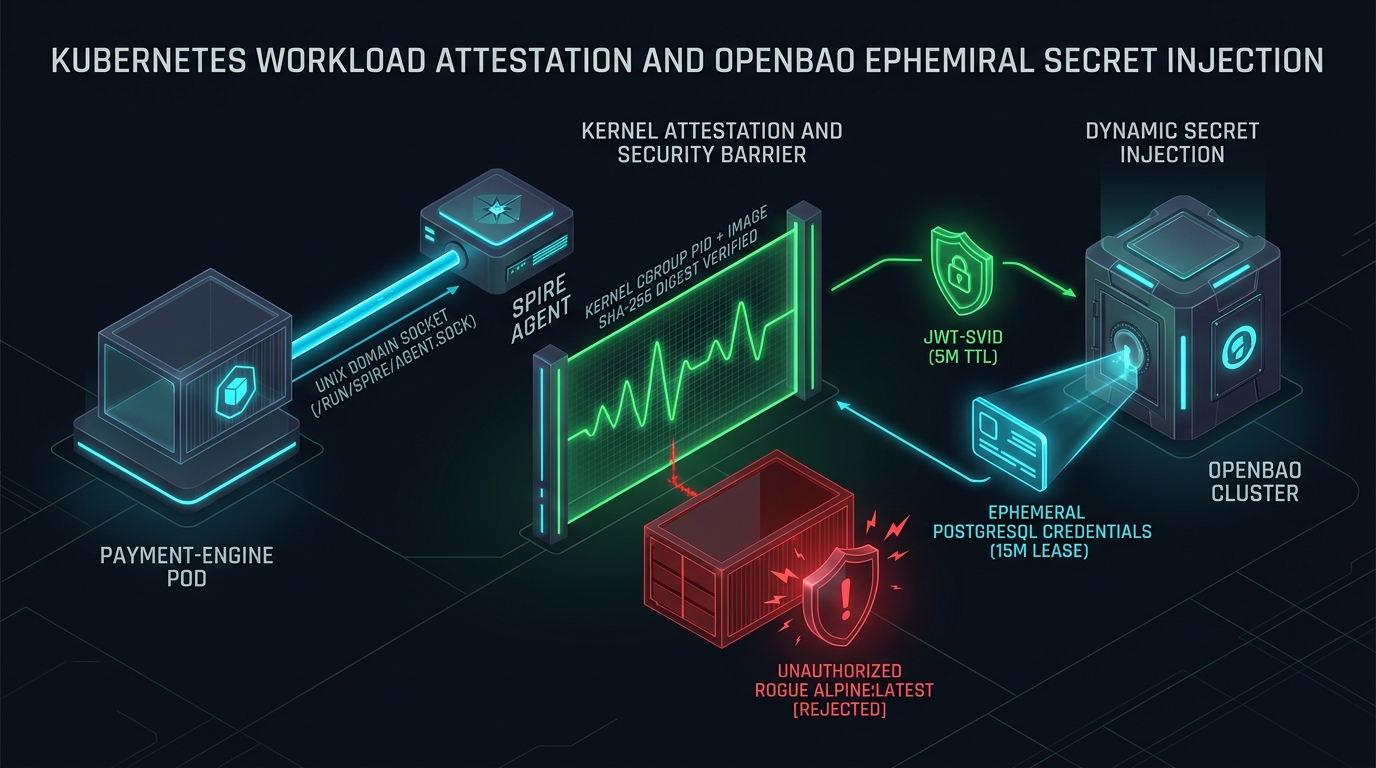
Suppose a pod runs in the prod namespace under the payment-engine ServiceAccount. What if an attacker compromises a CI/CD deployment variable or gains kubectl edit rights in that namespace and substitutes alpine:latest (or injects a malicious debug sidecar) running under the payment-engine ServiceAccount to exfiltrate database credentials?
Standard Kubernetes ServiceAccount tokens cannot stop this—because a Kubernetes token is bound only to (Namespace, ServiceAccount).
SPIRE closes this gap entirely. When an application pod opens a connection to the SPIRE Workload API socket (/run/spire/sockets/agent.sock, mounted read-only into the pod via the SPIFFE CSI Driver), the SPIRE Agent does not ask the pod who it is. Instead:
- The Linux kernel provides the unforgeable
SO_PEERCRED(PID,UID,GID) of the calling process over the Unix domain socket. - The SPIRE Agent inspects
/proc/<PID>/cgroupto determine the container’s runtime ID and queries the local Kubelet API (:10250/pods) +unixbinary inspector. - SPIRE evaluates the pod against our registered Selectors, which pin not only the namespace and ServiceAccount, but also the immutable container image SHA-256 digest and process UID/binary hash:
spire-server entry create \
  -spiffeID spiffe://tekromancy.internal/ns/prod/sa/payment-engine \
  -parentID spiffe://tekromancy.internal/spire/agent/tpm_devid/ef81a904c2d0184b \
  -selector k8s:ns:prod \
  -selector k8s:sa:payment-engine \
  -selector k8s:container-name:payment-engine \
  -selector k8s:pod-image:harbor.tekromancy.internal/prod/payment-engine@sha256:9f86d081884c7d659a2feaa0c55ad015a3bf4f1b2b0b822cd15d6c15b0f00a08 \
  -selector unix:uid:65532 \
  -x509SVIDTTL 900 \
  -jwtSVIDTTL 300
If an attacker launches alpine:latest or curlimages/curl inside that exact same pod or under that exact same payment-engine ServiceAccount, its k8s:pod-image SHA-256 digest fails the selector check. The SPIRE Agent rejects the Workload API socket request before an SVID is ever minted.
5. Zero-Secret Authentication to OpenBao
With hardware-attested, image-pinned SVIDs flowing to our pod over an in-memory tmpfs CSI socket, we can now eliminate static secrets in OpenBao (openbao/openbao).
OpenBao supports two cryptographic authentication paths with SPIFFE/SPIRE:
- JWT/OIDC Auth (
auth/jwt): The pod requests a 5-minuteJWT-SVIDwith audienceopenbao.tekromancy.internalfrom the SPIRE socket and exchanges it at/v1/auth/jwt/login. - TLS Certificate Auth (
auth/cert): The pod presents its 15-minuteX.509-SVIDclient certificate over mTLS directly to OpenBao’s listener, which validates the URI Subject Alternative Name (URI SAN: spiffe://tekromancy.internal/ns/prod/sa/payment-engine) against the SPIRE trust bundle.
Step 1: Configure OpenBao JWT Auth & Dynamic PostgreSQL Engine
# 1. Enable JWT/OIDC Auth in OpenBao pointing to SPIRE OIDC Discovery Provider
bao auth enable jwt

bao write auth/jwt/config \
  oidc_discovery_url="https://spire-oidc.tekromancy.internal" \
  oidc_discovery_ca_pem=@/run/spire/bundle/bundle.crt \
  bound_issuer="https://spire-oidc.tekromancy.internal" \
  default_role="payment-engine-role"

# 2. Bind the exact SPIFFE ID and audience to a least-privilege OpenBao policy
bao write auth/jwt/role/payment-engine-role \
  role_type="jwt" \
  bound_audiences="openbao.tekromancy.internal" \
  user_claim="sub" \
  bound_subject="spiffe://tekromancy.internal/ns/prod/sa/payment-engine" \
  token_policies="prod-postgres-dynamic-rw" \
  token_ttl="15m" \
  token_max_ttl="15m"

# 3. Configure OpenBao's Dynamic PostgreSQL Engine to synthesize 15-minute SQL users
bao secrets enable database

bao write database/config/prod-ledger \
  plugin_name="postgresql-database-plugin" \
  allowed_roles="payment-engine-db-role" \
  connection_url="postgresql://{{username}}:{{password}}@postgres.prod.svc:5432/ledger?sslmode=verify-full" \
  username="openbao_root_admin" \
  password="<rotated-immediately-via-bao-rotate-root>"

# Immediately rotate the root database password so no human knows it!
bao write -force database/rotate-root/prod-ledger

bao write database/roles/payment-engine-db-role \
  db_name="prod-ledger" \
  creation_statements="CREATE ROLE \"{{name}}\" WITH LOGIN PASSWORD '{{password}}' VALID UNTIL '{{expiration}}'; GRANT SELECT, INSERT, UPDATE ON ALL TABLES IN SCHEMA public TO \"{{name}}\";" \
  default_ttl="15m" \
  max_ttl="15m"
Step 2: Production Kubernetes Pod Manifest (payment-engine-deployment.yaml)
Here is the complete production Kubernetes Deployment manifest showing how the SPIFFE CSI Driver mounts /run/spire/sockets/agent.sock into memory and how the application (or spiffe-helper sidecar) continuously exchanges its JWT-SVID with OpenBao:
apiVersion: apps/v1
kind: Deployment
metadata:
  name: payment-engine
  namespace: prod
spec:
  replicas: 3
  selector:
    matchLabels:
      app: payment-engine
  template:
    metadata:
      labels:
        app: payment-engine
    spec:
      serviceAccountName: payment-engine
      automountServiceAccountToken: false # No K8s static token needed!
      securityContext:
        runAsNonRoot: true
        runAsUser: 65532
        runAsGroup: 65532
        seccompProfile:
          type: RuntimeDefault
      containers:
        - name: payment-engine
          image: harbor.tekromancy.internal/prod/payment-engine@sha256:9f86d081884c7d659a2feaa0c55ad015a3bf4f1b2b0b822cd15d6c15b0f00a08
          env:
            - name: SPIFFE_ENDPOINT_SOCKET
              value: "unix:///run/spire/sockets/agent.sock"
            - name: BAO_ADDR
              value: "https://openbao.tekromancy.internal:8200"
          volumeMounts:
            - name: spire-agent-socket
              mountPath: /run/spire/sockets
              readOnly: true
          securityContext:
            allowPrivilegeEscalation: false
            readOnlyRootFilesystem: true
            capabilities:
              drop: ["ALL"]
      volumes:
        - name: spire-agent-socket
          csi:
            driver: "csi.spiffe.io"
            readOnly: true
Notice automountServiceAccountToken: false and readOnlyRootFilesystem: true: the pod does not even mount a Kubernetes ServiceAccount token!
Step 3: Native Go Workload Code (go-spiffe/v2 → OpenBao)
Inside the payment-engine binary, fewer than 40 lines of Go code using github.com/spiffe/go-spiffe/v2 fetch a hardware-attested JWT-SVID over the Unix socket and trade it with OpenBao for a 15-minute PostgreSQL connection string:
package main

import (
	"bytes"
	"context"
	"encoding/json"
	"fmt"
	"net/http"
	"os"
	"time"

	"github.com/spiffe/go-spiffe/v2/svid/jwtsvid"
	"github.com/spiffe/go-spiffe/v2/workloadapi"
)

func fetchDynamicPostgresCreds(ctx context.Context) (string, error) {
	// 1. Connect to local SPIRE Agent over CSI Unix Domain Socket
	source, err := workloadapi.NewJWTSource(ctx, workloadapi.WithClientOptions(
		workloadapi.WithAddr(os.Getenv("SPIFFE_ENDPOINT_SOCKET")),
	))
	if err != nil {
		return "", fmt.Errorf("spire workloadapi connect failed: %w", err)
	}
	defer source.Close()

	// 2. Request a short-lived JWT-SVID bound to OpenBao's audience
	svid, err := source.FetchJWTSVID(ctx, jwtsvid.Params{
		Audience: "openbao.tekromancy.internal",
	})
	if err != nil {
		return "", fmt.Errorf("jwt-svid attestation rejected: %w", err)
	}

	// 3. Exchange the JWT-SVID with OpenBao for a 15-minute scoped token
	baoAddr := os.Getenv("BAO_ADDR")
	loginPayload, _ := json.Marshal(map[string]string{
		"role": "payment-engine-role",
		"jwt":  svid.Marshal(),
	})

	resp, err := http.Post(baoAddr+"/v1/auth/jwt/login", "application/json", bytes.NewReader(loginPayload))
	if err != nil || resp.StatusCode != http.StatusOK {
		return "", fmt.Errorf("openbao jwt login failed: status=%v err=%v", resp.StatusCode, err)
	}
	defer resp.Body.Close()

	var authResp struct {
		Auth struct {
			ClientToken string `json:"client_token"`
		} `json:"auth"`
	}
	if err := json.NewDecoder(resp.Body).Decode(&authResp); err != nil {
		return "", err
	}

	// 4. Request ephemeral 15-minute PostgreSQL credentials from OpenBao
	req, _ := http.NewRequestWithContext(ctx, "GET", baoAddr+"/v1/database/creds/payment-engine-db-role", nil)
	req.Header.Set("X-Vault-Token", authResp.Auth.ClientToken)

	dbResp, err := (&http.Client{Timeout: 5 * time.Second}).Do(req)
	if err != nil || dbResp.StatusCode != http.StatusOK {
		return "", fmt.Errorf("failed to lease dynamic db creds: %w", err)
	}
	defer dbResp.Body.Close()

	var creds struct {
		Data struct {
			Username string `json:"username"`
			Password string `json:"password"`
		} `json:"data"`
	}
	if err := json.NewDecoder(dbResp.Body).Decode(&creds); err != nil {
		return "", err
	}

	return fmt.Sprintf("postgres://%s:%s@postgres.prod.svc:5432/ledger?sslmode=verify-full",
		creds.Data.Username, creds.Data.Password), nil
}
6. Security & Operational Comparison
| Bootstrap & Identity Architecture | Disk Secret Exposure | Node Clone / NVMe Theft Protection | Bootloader / Evil-Maid Protection | Image Substitution Resistance | Rotation Interval |
|---|---|---|---|---|---|
Kubernetes Secret (Base64 in etcd) |
❌ High (Plaintext on disk/env) | ❌ None | ❌ None | ❌ None | Manual |
Vault AppRole (role_id + secret_id file) |
❌ Medium (Static secret_id on node) |
❌ Stolen disk authenticates | ❌ None | ❌ None | Manual / CI |
K8s Projected SA Token (TokenRequest) |
✅ Low (tmpfs memory) |
❌ Stolen kubelet PKI boots as node | ❌ Unmeasured boot | ❌ Namespace + SA only | 1 hour |
| TPM 2.0 + SPIFFE/SPIRE + OpenBao | ✅ Zero (Non-exportable Silicon) | ✅ Hardware-Bound EK/LDevID |
✅ PCR 0/2/4/7 Measured Boot | ✅ Pinned Image SHA-256 + UID | 5–15 minutes |
With TPM 2.0 hardware attestation anchored to SPIFFE/SPIRE and OpenBao, Secret Zero simply ceases to exist as a software artifact. From bare-metal power-on to SQL transaction, every credential in your cluster is ephemeral, hardware-attested, and cryptographically bound to both the physical motherboard silicon and the immutable container digest.
Interactive TPM 2.0 + SPIFFE/SPIRE + OpenBao Attestation Simulator
Simulate Evil Maid boot tampering, NVMe drive theft, and rogue container image substitution to observe how TPM 2.0 PCR quotes and SPIRE workload selectors halt unauthorized credential issuance.
Genuine motherboard TPM 2.0 EK, golden PCR 0/4/7 Measured Boot hashes, and SHA-256 pinned container image.
EK decrypted challenge; signed PCR 0/4/7 quote verified.
spiffe://tekromancy.internal/spire/agent/tpm_devid/node-01
Minted JWT-SVID (15m TTL) over tmpfs CSI socket.
Ephemeral Postgres user v-jwt-prod-715 active in RAM (0 disk secrets).
// ABOUT THE AUTHOR
Joshua Edward McLaughlin Cox
Technomancer & Systems ArchitectPassionate about low-level Linux systems engineering, high-scale Kubernetes deployments, local artificial intelligence pipelines, and defensive security. Building robust, sovereign computing environments that stand the test of time.