










Architecting a Global Overlay Mesh with WireGuard and Anycast BGP
Public cloud multi-region networking is notoriously expensive and prone to unpredictable cross-cloud egress fees. Building your own encrypted global overlay network spanning bare-metal servers, edge locations, and cloud providers gives you complete sovereignty over traffic paths, encryption, and routing policy.
In this architecture guide, we construct a full-mesh encrypted backbone using the Linux kernel’s native WireGuard protocol combined with dynamic BGP (Border Gateway Protocol) peering powered by BIRD.
Topology Overview
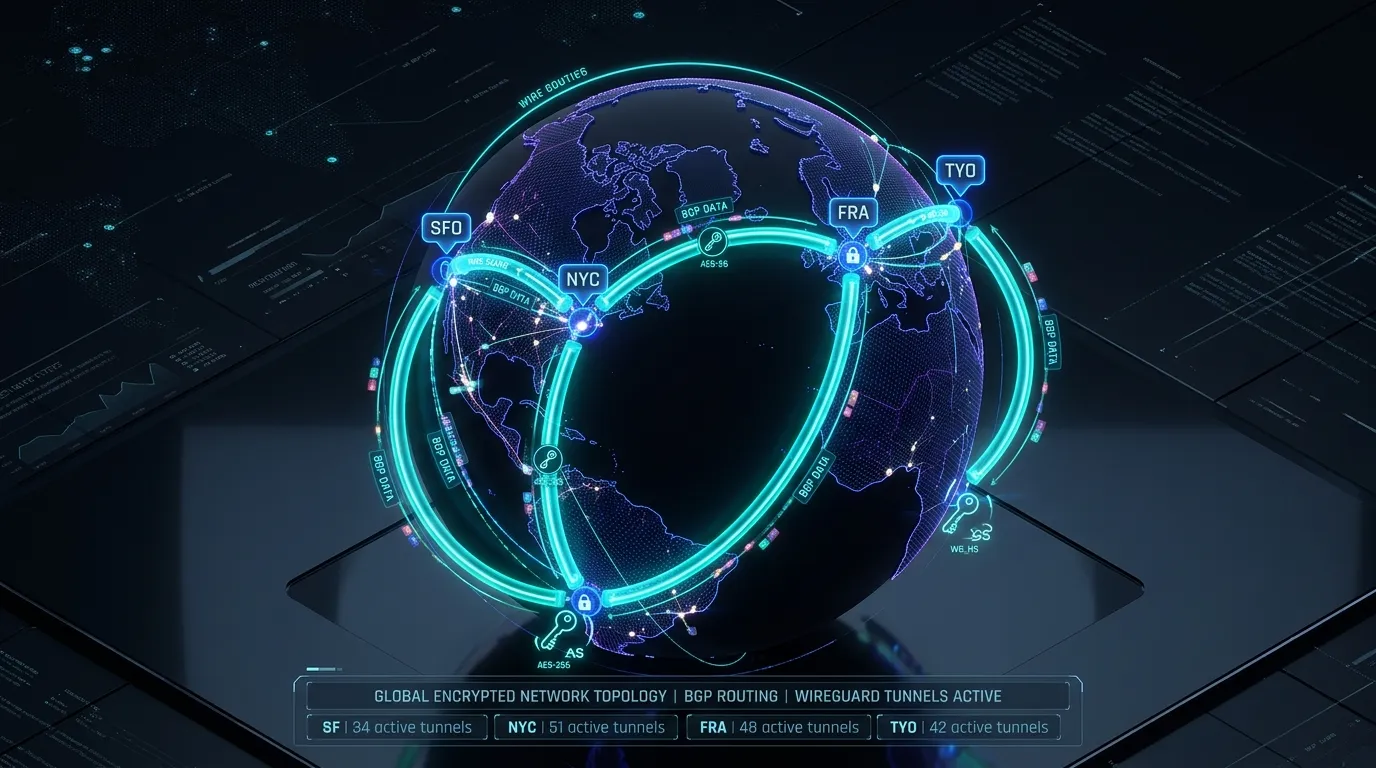
Instead of a fragile hub-and-spoke model where traffic hairpins through a single central gateway, we build a multi-node mesh where each edge router calculates optimal shortest paths:
[ US-East (NYC) ] <=========== WireGuard Tunnel ===========> [ EU-Central (FRA) ]
        ^                                                            ^
        |   \                                                    /   |
        |       \                                            /       |
   WireGuard        \                                    /       WireGuard
     Tunnel             \                            /             Tunnel
        |                   \                    /                   |
        v                       v            v                       v
[ US-West (SFO) ] <=========== WireGuard Tunnel ===========> [ AP-East (TYO) ]
Every link is authenticated with Noise-protocol cryptography in kernel space, and BGP distributes internal subnets (10.42.0.0/16) dynamically.
Setting Up WireGuard Tunnel Interfaces
On Linux 5.6+, WireGuard is built directly into the kernel. We create a point-to-point interface wg0:
# Generate private and public keys
umask 077
wg genkey | tee /etc/wireguard/private.key | wg pubkey > /etc/wireguard/public.key
Configuration /etc/wireguard/wg0.conf:
[Interface]
Address = 10.42.100.1/32
ListenPort = 51820
PrivateKey = <NYC_PRIVATE_KEY>
# MTU 1420 accounts for standard 1500 byte Ethernet minus WireGuard overhead
MTU = 1420

# Peer: Frankfurt Node
[Peer]
PublicKey = <FRA_PUBLIC_KEY>
Endpoint = fra.tekromancy.net:51820
AllowedIPs = 10.42.100.2/32, 10.42.2.0/24
PersistentKeepalive = 25

# Peer: Tokyo Node
[Peer]
PublicKey = <TYO_PUBLIC_KEY>
Endpoint = tyo.tekromancy.net:51820
AllowedIPs = 10.42.100.3/32, 10.42.3.0/24
PersistentKeepalive = 25
Bring up the tunnel:
sudo systemctl enable --now wg-quick@wg0Verify handshake latency:
sudo wg showinterface: wg0
public key: jEw9...=
listening port: 51820
peer: dKa2...=
endpoint: 198.51.100.42:51820
allowed ips: 10.42.100.2/32, 10.42.2.0/24
latest handshake: 14 seconds ago
transfer: 4.82 GiB received, 12.18 GiB sentDynamic Routing with BIRD (BGP)
Hardcoding static routes across multiple regions fails whenever an ISP fiber cut occurs. By running the BIRD routing daemon over WireGuard, routes re-converge in sub-second intervals.
Configuration snippet /etc/bird/bird.conf:
router id 10.42.100.1;

protocol kernel {
    ipv4 {
        export all;
    };
}

protocol device {
    scan time 10;
}

# Internal BGP Peer to Frankfurt
protocol bgp peer_fra {
    local 10.42.100.1 as 65001;
    neighbor 10.42.100.2 as 65002;
    ipv4 {
        import all;
        export all;
    };
    bfd yes;
}
With BFD (Bidirectional Forwarding Detection) enabled, if a packet is lost between NYC and Frankfurt for more than 300 milliseconds, BIRD immediately re-routes traffic across the trans-Pacific path through Tokyo or SFO with zero manual intervention.
Kernel Performance Tuning for 10Gbps+ Transit
Add the following to /etc/sysctl.d/99-network-tuning.conf:
# Enable IP Forwarding
net.ipv4.ip_forward = 1
net.ipv6.conf.all.forwarding = 1

# Increase buffer limits for high-bandwidth/delay product paths
net.core.rmem_max = 67108864
net.core.wmem_max = 67108864
net.ipv4.tcp_rmem = 4096 87380 67108864
net.ipv4.tcp_wmem = 4096 65536 67108864

# Use BBR Congestion Control
net.core.default_qdisc = fq
net.ipv4.tcp_congestion_control = bbr
Apply immediately:
sudo sysctl --systemResult
With this setup, packet loss drops dramatically, end-to-end telemetry is encrypted at line speed, and you are liberated from the exorbitant egress fees of legacy cloud providers.
// ABOUT THE AUTHOR
Joshua Edward McLaughlin Cox
Technomancer & Systems ArchitectPassionate about low-level Linux systems engineering, high-scale Kubernetes deployments, local artificial intelligence pipelines, and defensive security. Building robust, sovereign computing environments that stand the test of time.