











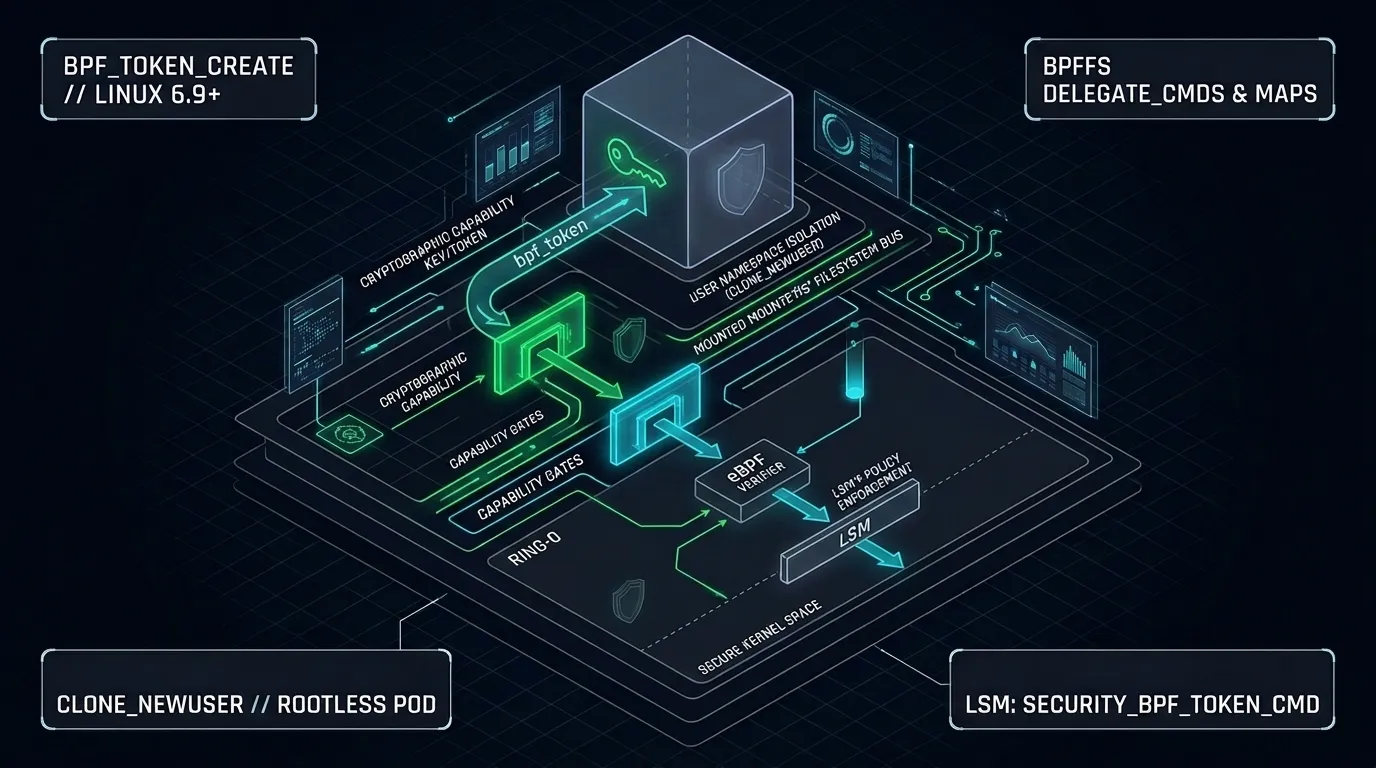
Safe Unprivileged eBPF in Multi-Tenant Containers: Deep Dive into Linux 6.9+ BPF Tokens (BPF_TOKEN_CREATE), User Namespaces, and bpffs Delegation
For years, Kubernetes platform and security engineers faced an impossible Catch-22 when running eBPF-powered workloads (such as rootless container profilers, per-pod XDP/TC service-mesh sidecars, or CI/CD runners testing eBPF programs) on multi-tenant Linux hosts:
- To load any eBPF program via
sys_bpf(BPF_PROG_LOAD, ...), the kernel historically requiredCAP_BPF(andCAP_PERFMONorCAP_NET_ADMIN) in the Initial User Namespace (init_user_ns)—i.e., real host root! - Why couldn’t the kernel simply check
ns_capable(current_user_ns(), CAP_BPF)to let a rootless container inside a User Namespace (CLONE_NEWUSER) load eBPF programs? Because an unprivileged user on the host can callunshare(CLONE_NEWUSER)at any time to gain fullCAP_BPFinside their new namespace, immediately bypassingsysctl kernel.unprivileged_bpf_disabled=1and exposing the entire Ring-0 verifier and kernel memory read helpers (bpf_probe_read_kernel) to local privilege escalation!
Introduced by Andrii Nakryiko in Linux 6.9+, BPF Tokens (BPF_TOKEN_CREATE / struct bpf_token) finally solve unprivileged eBPF delegation cleanly.
Instead of trusting ambient User Namespace capabilities, a privileged host daemon mounts a dedicated bpffs (sys_fs_Mount) instance configured with fine-grained delegation bitmasks (delegate_cmds, delegate_maps, delegate_progs, delegate_attachs) inside a target User Namespace, allowing rootless containers to derive a cryptographic capability fd (bpf_token_fd) verified by both the kernel and BPF_LSM (security_bpf_token_cmd).
1. How struct bpf_token & bpffs Delegation Work Inside the Kernel
Why did Linux tie BPF Tokens to a bpffs filesystem instance (kernel/bpf/inode.c and kernel/bpf/token.c) rather than creating a standalone syscalls-only token?
Because bpffs is already a kernel object bound to a specific User Namespace (sb->s_user_ns) at fsopen("bpf") creation time, and can only be configured (fsconfig) by a process holding CAP_SYS_ADMIN in the parent/initial namespace!
+-----------------------------------------------------------------------------------+
|         LINUX 6.9+ BPF TOKEN (BPF_TOKEN_CREATE) DELEGATION ARCHITECTURE           |
+-----------------------------------------------------------------------------------+
|                                                                                   |
|  [ PRIVILEGED HOST ORCHESTRATOR / CRI RUNTIME (`init_user_ns` + `CAP_SYS_ADMIN`) ]|
|    1. Creates User Namespace (`userns_fd`) for Rootless Container Pod             |
|    2. Opens `bpffs` via New Mount API (`fsopen("bpf")`) bound to `userns_fd`      |
|    3. Configures fine-grained bitmasks via `fsconfig()`:                          |
|       ├── `delegate_cmds   = (1 << BPF_PROG_LOAD) | (1 << BPF_MAP_CREATE)`        |
|       ├── `delegate_progs  = (1 << BPF_PROG_TYPE_SOCKET_FILTER) | (1 << XDP)`     |
|       ├── `delegate_maps   = (1 << BPF_MAP_TYPE_RINGBUF) | (1 << HASH)`           |
|       └── `delegate_attachs = (1 << BPF_XDP) | (1 << BPF_CGROUP_INET_INGRESS)`    |
|    4. Mounts `bpffs` at `/sys/fs/bpf` inside the Rootless Container               |
|                                      |                                            |
|  ------------------------------------+------------------------------------------  |
|                                      v                                            |
|  [ UNPRIVILEGED ROOTLESS CONTAINER (`container_user_ns`, Host UID 100000) ]       |
|    5. Opens `/sys/fs/bpf` (`bpffs_fd`)                                            |
|    6. Calls `token_fd = bpf(BPF_TOKEN_CREATE, { token_create.bpffs_fd })`         |
|    7. Calls `bpf(BPF_PROG_LOAD, { prog_type = XDP, prog_token_fd = token_fd })`   |
|       ├── Kernel checks `bpf_token_capable(token, CAP_BPF)` in `container_user_ns`|
|       ├── Kernel verifies `(token->allowed_progs & (1ULL << BPF_PROG_TYPE_XDP))`  |
|       └── `BPF_LSM` hook `security_bpf_token_cmd()` audits BTF & helper calls!    |
|                                                                                   |
+-----------------------------------------------------------------------------------+
The Three Security Invariants of bpf_token_capable()
When a rootless container process calls sys_bpf(BPF_PROG_LOAD, &attr, sizeof(attr)) and passes attr.prog_token_fd:
- User Namespace Ownership Match: In
bpf_token_capable(token, cap)(kernel/bpf/token.c), the kernel verifies that the calling process has capabilitycap(CAP_BPF,CAP_NET_ADMIN, orCAP_PERFMON) inside the exactuser_nsthat owns thebpffssuperblock (token->userns) vians_capable(token->userns, cap). - Bitmask Intersection Check: Even if the container holds
CAP_BPFinside its ownuser_ns, it cannot loadBPF_PROG_TYPE_KPROBEorBPF_PROG_TYPE_LSMunless the host orchestrator explicitly set those bits indelegate_progson thebpffssuperblock! - LSM Fine-Grained Inspection (
security_bpf_token_cmd/security_bpf_token_create): Even within an allowed program type (e.g.,BPF_PROG_TYPE_SCHED_CLS), an eBPF LSM program on the host can inspect thestruct bpf_token *and reject specific dangerous kfuncs or helper IDs.
2. Provisioning a Delegated bpffs Instance via the Linux Mount API (fsopen / fsconfig)
To configure delegate_cmds, delegate_progs, delegate_maps, and delegate_attachs, you use the modern Linux file-descriptor mount API (sys_fsopen, sys_fsconfig, sys_fsmount, sys_move_mount) introduced in Linux 5.2+ and extended for bpffs in Linux 6.9+:
// setup_delegated_bpffs.c — Host daemon provisioning a scoped BPF Token mount
#define _GNU_SOURCE
#include <sys/mount.h>
#include <sys/syscall.h>
#include <linux/bpf.h>
#include <fcntl.h>
#include <unistd.h>
#include <stdio.h>
#include <stdint.h>

static inline int sys_fsopen(const char *fsname, unsigned int flags) {
    return syscall(__NR_fsopen, fsname, flags);
}

static inline int sys_fsconfig(int fd, unsigned int cmd, const char *key,
                               const void *val, int aux) {
    return syscall(__NR_fsconfig, fd, cmd, key, val, aux);
}

static inline int sys_fsmount(int fd, unsigned int flags, unsigned int attr_flags) {
    return syscall(__NR_fsmount, fd, flags, attr_flags);
}

int mount_scoped_bpffs_for_container(const char *target_path) {
    // 1. Open a new bpffs filesystem context inside the target User Namespace
    //    (Caller enters the container's user_ns before calling fsopen("bpf"),
    //     then switches back to init_user_ns to configure delegate_* options!)
    int fs_fd = sys_fsopen("bpf", FSOPEN_CLOEXEC);
    if (fs_fd < 0) return -1;

    // 2. Allow ONLY BPF_MAP_CREATE, BPF_PROG_LOAD, BPF_BTF_LOAD, and BPF_LINK_CREATE
    uint64_t cmds_mask = (1ULL << BPF_MAP_CREATE) |
                         (1ULL << BPF_PROG_LOAD)  |
                         (1ULL << BPF_BTF_LOAD)   |
                         (1ULL << BPF_LINK_CREATE);

    // 3. Allow ONLY safe networking program types (XDP and TC / SCHED_CLS)
    //    (Strictly block KPROBE, TRACEPOINT, LSM, and RAW_TRACEPOINT!)
    uint64_t progs_mask = (1ULL << BPF_PROG_TYPE_XDP) |
                          (1ULL << BPF_PROG_TYPE_SCHED_CLS) |
                          (1ULL << BPF_PROG_TYPE_SOCKET_FILTER);

    // 4. Allow ONLY Array, Hash, and Ringbuf maps
    uint64_t maps_mask = (1ULL << BPF_MAP_TYPE_ARRAY) |
                         (1ULL << BPF_MAP_TYPE_HASH)  |
                         (1ULL << BPF_MAP_TYPE_RINGBUF);

    uint64_t attachs_mask = (1ULL << BPF_XDP) | (1ULL << BPF_TCX_INGRESS);

    char buf[32];
    snprintf(buf, sizeof(buf), "0x%llx", (unsigned long long)cmds_mask);
    sys_fsconfig(fs_fd, FSCONFIG_SET_STRING, "delegate_cmds", buf, 0);

    snprintf(buf, sizeof(buf), "0x%llx", (unsigned long long)progs_mask);
    sys_fsconfig(fs_fd, FSCONFIG_SET_STRING, "delegate_progs", buf, 0);

    snprintf(buf, sizeof(buf), "0x%llx", (unsigned long long)maps_mask);
    sys_fsconfig(fs_fd, FSCONFIG_SET_STRING, "delegate_maps", buf, 0);

    snprintf(buf, sizeof(buf), "0x%llx", (unsigned long long)attachs_mask);
    sys_fsconfig(fs_fd, FSCONFIG_SET_STRING, "delegate_attachs", buf, 0);

    // 5. Instantiate the superblock and mount it into the container's /sys/fs/bpf
    sys_fsconfig(fs_fd, FSCONFIG_CMD_CREATE, NULL, NULL, 0);
    int mnt_fd = sys_fsmount(fs_fd, FSMOUNT_CLOEXEC, 0);
    syscall(__NR_move_mount, mnt_fd, "", AT_FDCWD, target_path, MOVE_MOUNT_F_EMPTY_PATH);

    close(mnt_fd);
    close(fs_fd);
    return 0;
}
Or directly from the command line on Linux 6.9+ (util-linux 2.40+) when configuring a container’s bpffs:
# Mount a bpffs instance delegating ONLY XDP & Socket Filter programs + Hash/Ringbuf maps:
mount -t bpf bpffs /var/lib/containers/pod-net/sys/fs/bpf \
  -o delegate_cmds=prog_load:map_create:btf_load:link_create,\
delegate_progs=xdp:socket_filter:sched_cls,\
delegate_maps=hash:array:ringbuf,\
delegate_attachs=xdp:tcx_ingress

# Inside the unprivileged container: libbpf 1.4+ automatically discovers /sys/fs/bpf,
# calls bpf(BPF_TOKEN_CREATE), and passes token_fd to every map/prog load!
# Or specify a custom path via BPF_OBJECT_OPEN_OPTS:
export LIBBPF_BPF_TOKEN_PATH=/sys/fs/bpf
3. Security Comparison: Privileged Pod vs. Host CAP_BPF vs. BPF_TOKEN_CREATE
| Container eBPF Deployment Model | Host init_user_ns Capabilities Needed in Pod |
Can Pod Read Arbitrary Kernel RAM (bpf_probe_read_kernel)? |
Can Pod Attach kprobes to Host sshd / kubelet? |
Multi-Tenant Blast Radius |
|---|---|---|---|---|
privileged: true Pod |
Full Host CAP_SYS_ADMIN |
Yes (Total Host Compromise) | Yes | Catastrophic (Trivial host root escape) |
Host CAP_BPF + CAP_NET_ADMIN |
Host CAP_BPF + CAP_NET_ADMIN |
No (Unless CAP_PERFMON also granted) |
No (CAP_PERFMON needed), but can manipulate all init_user_ns BPF maps |
High (Global BPF subsystem access) |
Rootless CLONE_NEWUSER + BPF_TOKEN_CREATE |
ZERO Host Capabilities (UID 100000) |
No (delegate_progs blocks tracing/kprobe!) |
No (Strictly scoped to container netns + allowed bitmask) |
Minimal (Least-Privilege Scoped) |
// ABOUT THE AUTHOR
Joshua Edward McLaughlin Cox
Technomancer & Systems ArchitectPassionate about low-level Linux systems engineering, high-scale Kubernetes deployments, local artificial intelligence pipelines, and defensive security. Building robust, sovereign computing environments that stand the test of time.