












Announcing SpareTank: Intelligent Battery Longevity & Emergency Power Guard for Android
Modern smartphones pack astonishing computational density: multi-gigahertz ARM cores, tensor processing units, high-refresh OLED matrices, and multi-band 5G radios. Yet every single one of these capabilities rests upon an electrochemical component that has barely changed in thirty years: the lithium-ion pouch cell.
Within eighteen months of unmanaged charging, most users notice their device bleeding charge by late afternoon. Battery health drops to 80% or lower, internal cell resistance spikes, and unexpected shutdowns begin occurring in cold weather. The hardware industry’s standard prescription is planned obsolescence: pay for an expensive authorized service replacement or purchase a new flagship.
Today, Tekromancy is announcing SpareTank, a sovereign Android utility and battery longevity coach engineered to combat electrochemical cycle degradation and guarantee you never find yourself stranded with a dead device.
Explore the live portal and interactive battery retention simulator at sparetank.tekromancy.com.
1. The Electrochemistry of Battery Degradation
To understand why smartphones degrade so rapidly, one must examine the internal physical stresses of lithium-ion (Li-ion) chemistry:
+-----------------------------------------------------------------------------+
|                     LITHIUM-ION ELECTROCHEMICAL STRESS ZONES                |
|                                                                             |
|  [0% ---------------- 25%] ========== [25% ---------- 75%] ========== [75% - 100%]
|        CRITICAL ZONE                    SWEET SPOT               CRITICAL ZONE   |
|   - Copper foil dissolution        - Minimal volume change   - High voltage (4.4V) |
|   - SEI layer breakdown            - Low thermal dissipation - SEI layer oxidation|
|   - Structural cathode collapse    - 3x - 4x cycle lifespan  - Cathode cracking   |
+-----------------------------------------------------------------------------+- High State-of-Charge (SoC > 75%) Stress: When a battery is charged above 80% (approaching 4.35V–4.45V per cell), mechanical lattice stress on the cathode reaches its peak. At this elevated potential, electrolyte oxidation accelerates, precipitating thick Solid Electrolyte Interphase (SEI) growth that permanently traps active lithium ions.
- Deep Discharge (SoC < 25%) Stress: Below 20%, the anode potential rises significantly. In deep discharge states, copper current collector dissolution can occur, leading to dangerous internal micro-shorts, irreversible capacity fade, and impedance buildup.
- The 0%–100% Full-Cycle Penalty: Cycling a lithium cell continuously through 100% depth-of-discharge (DoD) typically yields merely 300 to 500 equivalent full cycles before capacity drops below 80%. Conversely, constraining cycles between 25% and 75% reduces mechanical strain, enabling the same cell to deliver 1,500 to 2,500 cycles—effectively tripling the useful lifespan of your hardware.
2. Why OEM “Battery Protection” Settings Fall Short
In recent Android releases, Google, Samsung, and Sony introduced basic “Protect Battery” switches that cap maximum charging at 80% or 85%. While a welcome step, this addresses only half of the electrochemical equation:
- Zero Lower-Bound Defense: An 80% ceiling prevents top-end voltage stress, but the phone still discharges down to 0%. Users drain the device into the high-stress deep-discharge zone every night.
- The “Dead Phone” Ambush: By limiting top capacity to 80% without an active management strategy, users run out of power earlier in the day, frequently stranding them without navigational aids, rideshare access, or emergency communications.
- Passive vs. Active Coaching: Stock settings are static and opaque. They offer no dynamic insight into cycle counts, temperature coefficient metrics, or real-world capacity retention projections.
3. The SpareTank Architecture: The 15% Emergency Reserve
SpareTank solves this dilemma by introducing a paradigm borrowed from aviation and long-range expedition fuel tanks: the dedicated reserve tank.
+-----------------------------------------------------------------------------+
|                           SPARETANK ENERGY PARTITION                        |
|                                                                             |
|  [ 0% -------- 15% ] ======================== [ 15% ------------------- 75% ]
|     EMERGENCY SPARE TANK                          ACTIVE DAILY DUTY CYCLE   |
|   - Untouched during daily routines             - Protected 25%-75% window  |
|   - Preserved for critical emergencies          - Zero mechanical fatigue   |
|   - Navigation, calls, 2FA tokens               - Gentle cyclic throughput  |
+-----------------------------------------------------------------------------+
The 25%–75% Smart Charging Coach
SpareTank continuously monitors battery hardware registers via low-overhead Android broadcast receivers. When charging, custom high-contrast audio/haptic alerts notify you the moment your cell reaches 75%–80%, prompting you to disconnect before high-voltage plating occurs. When discharging during normal daily routines, early low-battery alerts fire at 25%, reminding you to top up before entering deep-discharge fatigue.
The 15% Guaranteed Emergency Spare Tank
If you are away from power and cannot charge, SpareTank treats 15% remaining capacity as your operational zero. By alerting you proactively at 15%, the app prompts you to engage power-saving measures, close background tasks, and preserve that untouched 15% “spare tank” strictly for when an emergency strikes—such as ordering a ride home, making an urgent phone call, or accessing critical two-factor authentication keys.
4. Real-World Longevity: The Math Behind Capacity Retention
On the official sparetank.tekromancy.com portal, we have published an interactive degradation calculator grounded in peer-reviewed battery degradation literature (Ecker et al., Journal of Power Sources).
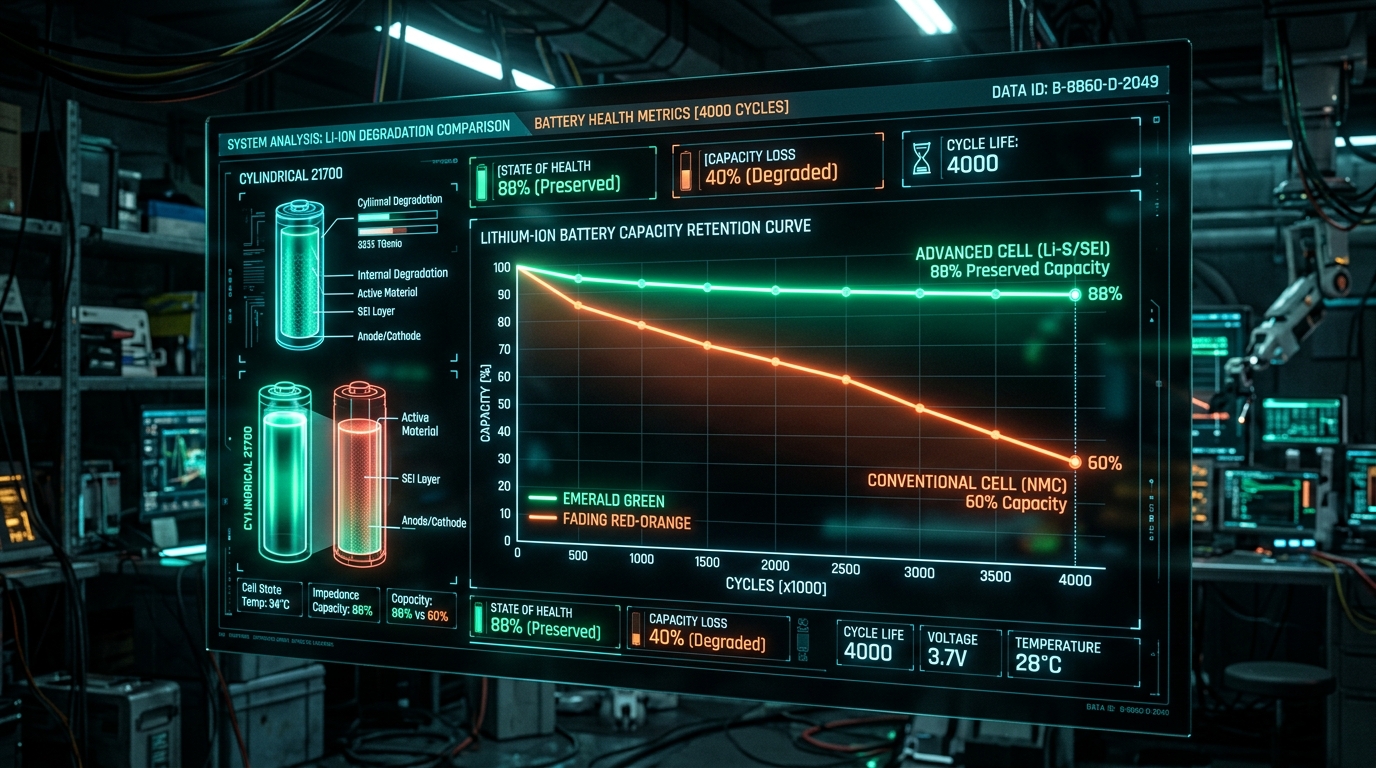
Consider a standard 5,000 mAh smartphone battery over a 3-year deployment cycling 1.25 times per day:
| Metric | Standard Unmanaged Charging | SpareTank Guided Protocol | Benefit |
|---|---|---|---|
| Charge Window | 0% – 100% Full Depth | 25% – 75% Sweet Spot | Reduced lattice stress |
| Equivalent Cycles | ~1,368 full deep cycles | ~1,368 partial shallow cycles | 60% lower SEI growth |
| 3-Year Capacity Retained | 68% (~3,400 mAh) | 88% (~4,400 mAh) | +1,000 mAh preserved |
| Usable Hardware Lifespan | ~1.5 to 2 Years | 4 to 5+ Years | 2.5x hardware longevity |
By keeping cell throughput in the shallow 25%–75% region, SpareTank preserves up to one full ampere-hour of battery capacity that would otherwise be permanently lost to thermal and electrochemical wear.
5. The Tekromancy Privacy & Performance Covenant
Background utility apps have a notorious reputation on mobile platforms for draining the very battery they claim to monitor. SpareTank was architected under strict systems engineering discipline:
- Negligible Power Footprint (< 0.1% background drain): SpareTank utilizes event-driven
Intent.ACTION_BATTERY_CHANGEDbroadcast receivers rather than aggressive CPU polling loops. The app sleeps until hardware battery state registers transition. - 100% On-Device Processing: Every battery calculation, longevity estimate, and alert rule executes locally in device memory.
- Zero Surveillance SDKs: No third-party ad networks, no analytics trackers, and no background telemetry connections to external cloud servers.
- No Account Required: Instant utility right out of the box with zero sign-ins or cloud dependencies.
6. Editions & Closed Beta Access
SpareTank is rolling out under a clean, accessible distribution model:
- SpareTank Free Edition: Core 25%–75% charging alerts, 15% emergency reserve notifications, real-time battery status HUD, zero ads, and 100% on-device privacy.
- SpareTank Pro Edition ($2.99 USD): Customizable alert thresholds (e.g., 20%–80%, 30%–70%), advanced degradation simulation curves, per-charger acoustic profiles, and home screen widget support.
Join the Closed Beta Track
The Google Play closed beta is open to early adopters:
- Visit the Portal: Check out sparetank.tekromancy.com to test the live capacity retention simulator.
- Download on Google Play: Test builds via the Google Play Closed Beta Track.
- Submit Verification: To join the private testing group, send an email to
tekromancy@googlegroups.comor connect via our Contact Gateway.
7. The Sovereign Software Suite
SpareTank and Silent Mode Control represent Tekromancy’s commitment to building utilitarian, sovereign tools for everyday hardware. By pairing intelligent battery conservation with granular telecom notification screening, users gain total authority over their personal devices.
View our complete roster of mobile applications and systems tools in the Apps Section.
Interactive Electrochemical Retention Simulator
Adjust target charge thresholds to observe projected 3-year capacity retention and cycle lifespan multipliers in real time.
// ABOUT THE AUTHOR
Joshua Edward McLaughlin Cox
Technomancer & Systems ArchitectPassionate about low-level Linux systems engineering, high-scale Kubernetes deployments, local artificial intelligence pipelines, and defensive security. Building robust, sovereign computing environments that stand the test of time.